• Tatlin’s Tower, London
Tuesday, 18 October 2011 Leave a comment
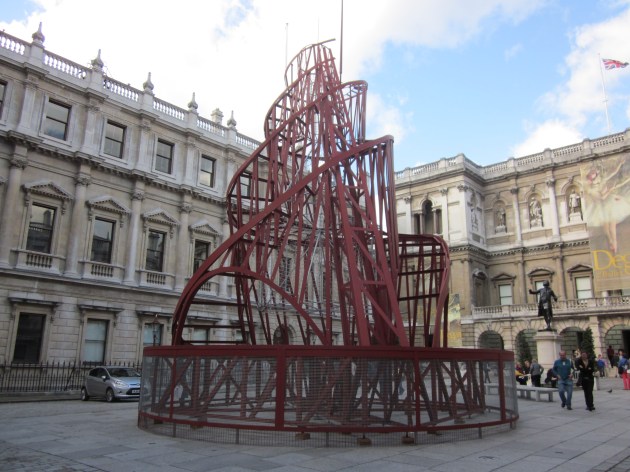
Three angles on the reconstruction of Tatlin’s Tower currently gracing the courtyard of the Royal Academy.


… on the arts and the outdoors
Tuesday, 18 October 2011 Leave a comment
Three angles on the reconstruction of Tatlin’s Tower currently gracing the courtyard of the Royal Academy.
Friday, 14 October 2011 Leave a comment
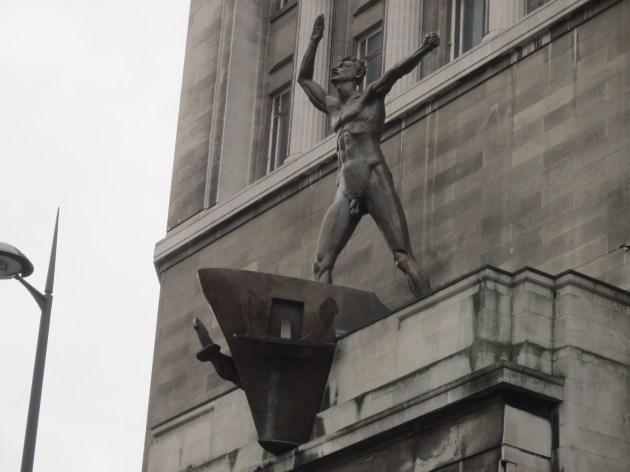
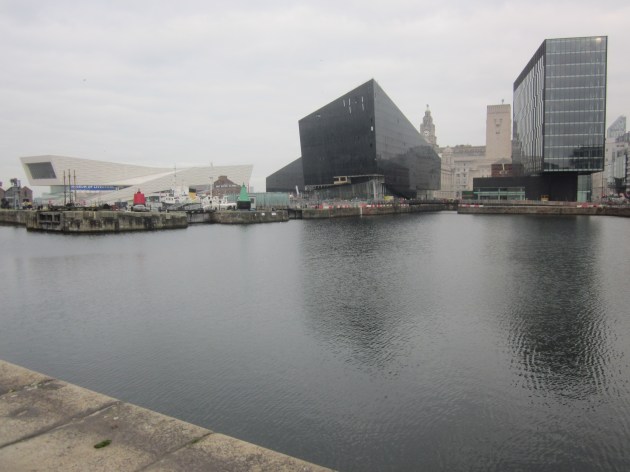
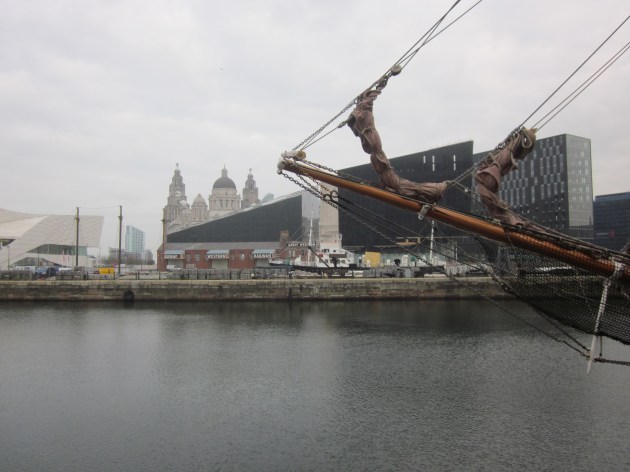
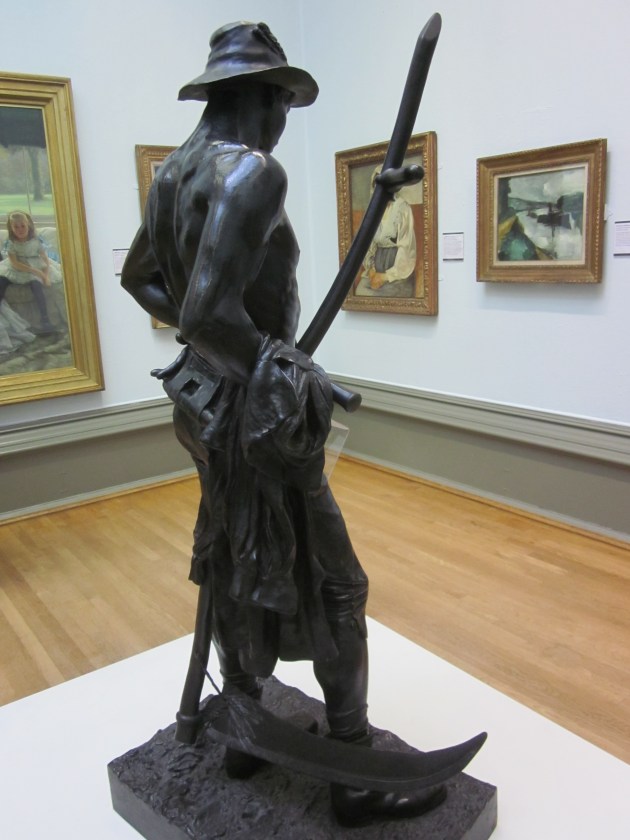
On today’s day-trip to see the Magritte exhibition at Tate Liverpool, I wandered around the city and riverside, my first visit in decades. Here are a few snaps of this radically changed cityscape, ending with shots of The Mower (1881), by William Hamo Thorneycroft, in the Walker Gallery.





Sunday, 9 October 2011 Leave a comment
Part natural, part human: the shaping of trees, out of the ordinary and down in the valley at the Lost Gardens of Heligan. The ‘human’ involved is the artist James Eddy.


Wednesday, 21 September 2011 Leave a comment
 In his many self-portraits, Gustave Courbet (1819-77) gives himself the air of a wild man. They vibrate with a visceral energy that reminds me of Michelangelo Merisi da Caravaggio (1571-1610). But I would rather trust Caravaggio than Courbet with the faithful representation of musicians and how musical instruments are held or played.
These two youthful self-portraits – above, The Cellist (1848), now in the National Museum in Stockholm, and, below, the earlier The Violoncellist (1847), now in the Portland Art Museum – are fascinating for a number of reasons.

Courbet wasn’t musical and didn’t play any instrument. He’s also playing left-handed, which is very rare. There’s no evidence that he was left-handed as a painter. Was he looking in a mirror?
The way in which Courbet is ‘playing’ the cello is a joke. For starters, he’s wearing it far too off-the-shoulder, like a louche model giving the come-on. In fact, while his left arm gives the impression of playing, his right hand is doing nothing, just resting on the neck where it meets the body of the instrument. His extremely long fingers, vividly painted, are in no position to stop a string for the bow to resonate. So it’s merely a painterly pose, with no genuine attempt to portray the act of cello playing. Commentators have remarked that the bow is a metaphor for his paint brush. If so, then we might equally see the position of his right hand as if holding his painter’s palette.
That’s all fine and dandy, but to suggest that these paintings are a metaphor for the act of painting ignores the fact that the musical side of the equation is inadequate, not to say unreal. Does that not have an impact on the other side of the equation, implying that his art is sloppily thought through? That clearly is absurd. But anyone with a knowledge of music and its performance is bound to be puzzled and dismayed by Courbet’s cavalier attitude to musical practicality or accuracy. He might just as well have painted himself with a brush and palette, and have done with it, because the musical parallels are so deficient. The modern equivalent is the miming on film and TV which purports to show a singer or player in the act of genuine performance when this is patently not the case. Non-musicians often aren’t in the least bothered by such fakery, not understanding or caring how musical performance works. Courbet shared this attitude. Realism had its limits.
There is, however, a uniquely strange aspect to one of these self-portraits. The earlier one, immediately above, has been vandalised. This remains one of the most extraordinary acts in the history of pre-twentieth-century art. For reasons which remain a mystery, Courbet cut out the blank top right quarter of the picture and substituted a new piece of canvas with an image of multiple layers of printed music on a stand. The music is irrelevant to the main image, however, except as a prop on the side, because Courbet’s eyes are totally fixed on the viewer (or on himself, the poser/poseur, in the mirror).
If it wasn’t apparent at first glance, it quickly transpires that the musical deficiencies of this pair of paintings, and the cut-and-paste of the Portland version, are irrelevant. Courbet has set out to disturb and disquiet, ensuring that the only reality is his own ego: that face and those hands. Nothing else matters, as if provocatively suggesting that the viewer can get lost (or any one of numerous other rude rejoinders) if he or she doesn’t like it. Yet we come back for more. That’s the power of his personality.
Monday, 19 September 2011 Leave a comment
 Aren’t words wonderful? There I was, looking for a brief post, and my eyes lit upon this image. It’s called Le Sabordage, another in the series of inspired photographs by Robert Doisneau in collaboration with the whacky cellist Maurice Baquet.
• Not knowing what sabordage meant, I had to scurry to my Harrap’s Shorter French and English Dictionary (1).
• On the way, I knocked over the family’s Old English coal bucket (2).
• And I discovered that it means the deliberate sinking of one’s own ship (3).
Friday, 9 September 2011 Leave a comment
Is someone at the Tate trying to tell us that the entrance refurbishment hasn’t exactly gone to plan?
And woe betide you if you leave your hoodie in the cloakroom.
Thursday, 8 September 2011 Leave a comment

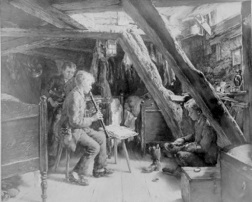
Here’s an artist completely new to me. Otto Piltz (1846-1910) was born in Thüringen in central Germany and lived at various times in Weimar and Munich. Some of his work is rather sentimental in tone and subject matter, but he was evidently interested in musical topics. He spent time during 1888-98 at his sister’s house in Sömmerda in rural Thüringen where there was a music school. Some of his depictions of the students rehearsing in attics and quiet corners – familiar to anyone who’s been at a full-time or summer music school! – are reproduced below. There’s also a painting of a church choir rehearsal.
Quintet is the best-known of these works, although it currently languishes in the vaults of the Victoria & Albert Museum in London. Dated between 1888 and the early 1890s, it has various titles, including Quintette der Gehilfen des Stadtpfiefers (there is a trombone hanging on the rear wall). The poor domestic interior is typical of such group pictures and belongs to the same European genre that gave rise to the much more visceral The Potato Eaters, which Van Gogh painted a few years earlier.
In Piltz’s painting, the five young musicians are gathered in time-honoured fashion around a table on which lie their individual parts (some propped up). They seem fairly well dressed. The near violinist (who perhaps looks older than the others) is sitting on a slatted wooden bench and there is a bed behind the cellist. The lamp is not lit, so they are reliant on the dim light coming from the deeply recessed window. It’s not a standard string quintet line-up (usually 2 violins, 2 violas and cello or 2 violins, viola and 2 cellos). The presence of the double-bass implies activities connected with civic occasions rather than concert repertoire. It’s not possible to be certain if there are 3 violins or 2 violins and viola because of the gloom. The players, however, look rather content. They certainly look more lively, musically, than the cellists in the near-contemporaneous pictures by Eakins and Hammershoi that I posted 11 days ago.


Tuesday, 6 September 2011 Leave a comment

Hiroshige Shōno - Hakuu/Shōno - Sudden Rain (1831-34)
Ochiba ochi
kazanarite ame
ame wo utsu
Falling leaves fall,
pile up; rain
on rain, beats
Gyōdai (1732-93)
Monday, 5 September 2011 Leave a comment
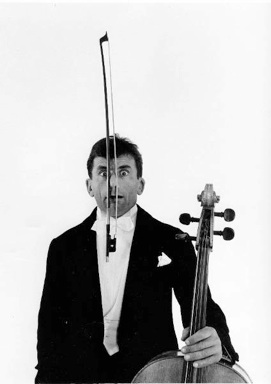
This was the first of Robert Doisneau’s photographs of Baquet that I ever saw. I bought it in a wonderful postcard shop in Tribeca, New York, some time in the 1980s. It still makes me smile!
Baquet was a remarkably versatile man. Here’s a 21” clip from a French newsreel of 1946. Paris was in deep snow and Baquet – an Olympic skier – took advantage. There are scenes of Paris streets and a view including Montmartre’s famous Moulin de la Galette (painted by many French artists and van Gogh). The newsreel finishes with Baquet skiing the broad steps in front of Sacré-Coeur and straight down a much narrower flight.
I’ve just come across another historic clip, but one which is viewable only on a French site (ina.fr). Click on the thumbnail image below. It’s a recording from what seems to be a French TV variety show and was broadcast by RTF on 12 May 1958. It’s a 6’ sketch called Le Quatuor, which comprises four cellists (not the standard quartet line-up), with the three on the left playing straight men to Baquet’s clowning. Doisneau’s image above reappears halfway through Baquet’s routine. It may seem a bit dated now, but his comedic imagination is sharply honed, as is his command of the cello. He really could play!
Tuesday, 30 August 2011 Leave a comment
 After posting yesterday’s exuberant image, I recalled the work of the great French photographer Robert Doisneau (1912-94), one of whose close friends was the cellist, actor, singer, comedian – and alpinist, Maurice Baquet (1911-2005). Together they created a body of photographic images that are unrivalled for their whimsical take on life and performance.
To mark the centenary of their births this year and next, here’s one of my favourites, Les attentions courtesies (c.1942-48). There’s something touchingly chivalrous, if irrelevant in Baquet’s action: he gets wet for the sake of his cello, which is perfectly dry anyway (that is, if it is inside). It could be a still from a French film.
Can anyone identify the location?


 Cornish Adrian