• Saturday Walk

Even though it was still dark when I set out, and I had a dreadful night unable to sleep, my Saturday walk to collect the paper cleared the brain a bit.  I never tire of this walk.  It’s just under four miles and on a good day it takes me under 70′, even though it’s mostly uphill to the PO.  The route takes me through the village, where overnight a spring (the watery variety) had broken through the tarmac and where errant sheep were looking for new pastures.  Then it was out and up onto the moor.

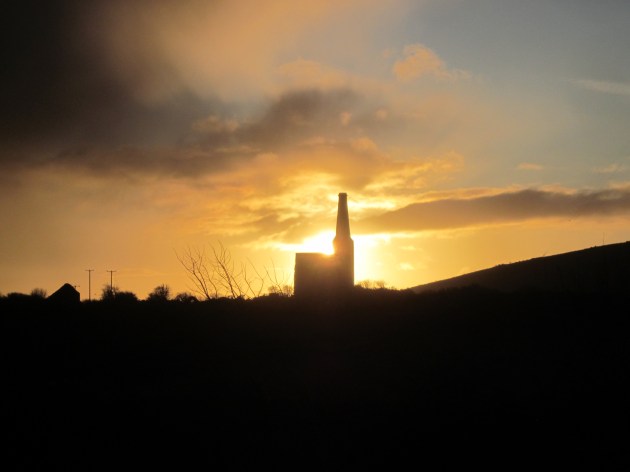
The views are fantastic, even on a dreary morning like today.  By the time I got up onto the top level, the sun was trying to poke his head round the clouds, but he didn’t have his hat on.  And the old mine engine house looked impressive in silhouette.
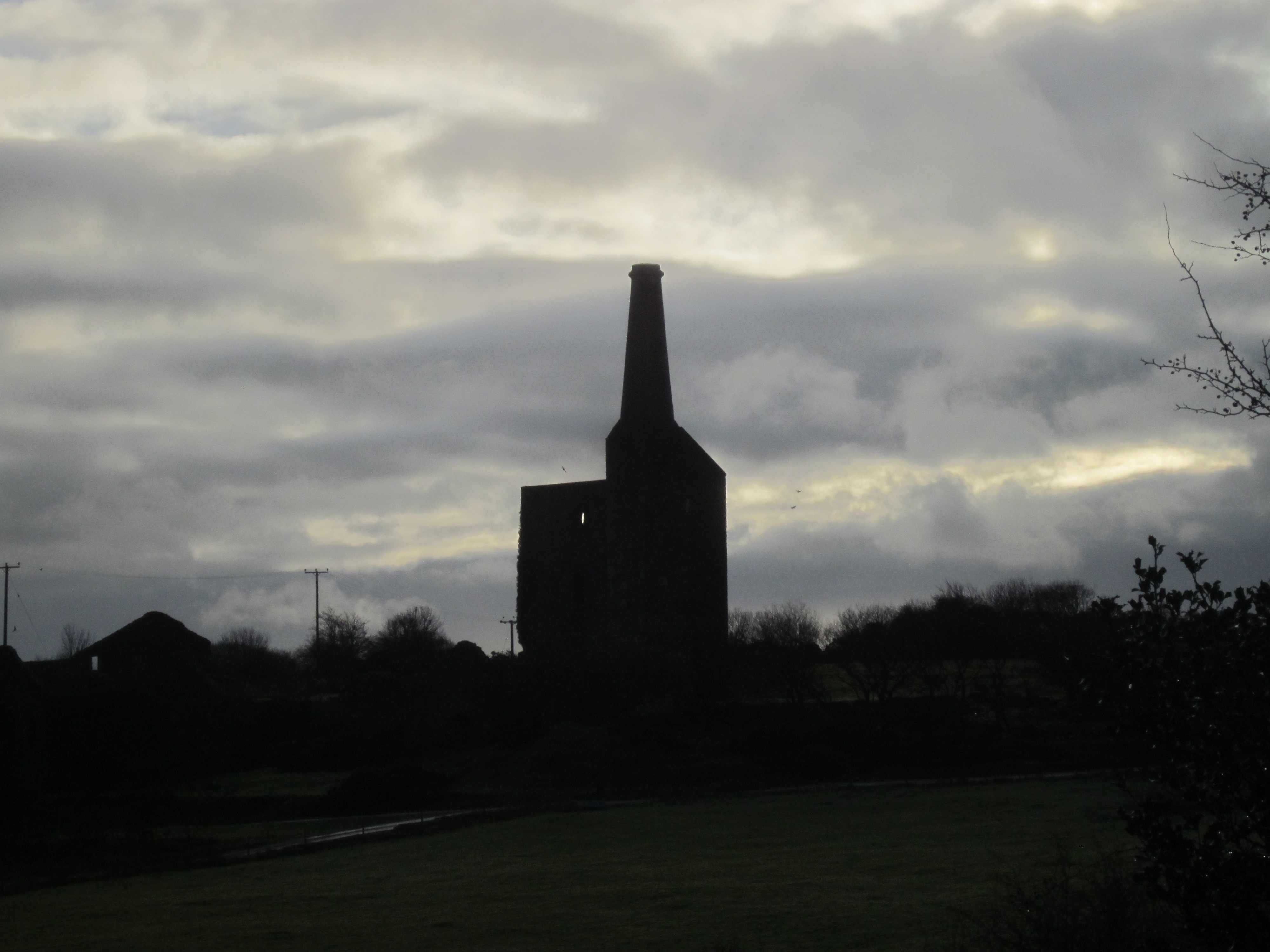
At this time of the morning I meet the occasional dog-owner, horse-rider, jogger and rock-climber.  Local farmers are out on their tractors, pronged silage bales trembling fore and aft, heading for their cattle and ponies up on the moor.

The way back offers a range of spectacular views, depending only on whether I retrace my steps on the road, or cut off along an old quarry railway track, or scramble up and over one of the more striking tors.  I took the easy option this morning and hurried home for breakfast and a good read of the Guardian.  Most importantly, and saved until the end, is the Berger&Wyse food cartoon in the magazine.  It was a gentle one today, but they never fail to make me smile, even if it is, for a while, out of perplexity.

On the lane near the house, the snowdrops have been out for several weeks, especially in a spot which catches the early-morning sun.

I was particularly happy to see that the snowdrops by the track to the house have at last started finding their way through the tangle of ivy and last year’s bracken.  They’re always the last to appear, maybe because they’re in the shade.  At the moment, they’re minute: the tallest is not even 2″ high, and none has yet opened up.  My little Ixus is not great for close-up detail, but here are two shots of one clump taken very close to.

These delicate white miracles lighten the spirit in an extraordinary way.

• Lunch on the grass

While posting yesterday on the planned new concert hall in Katowice, I remembered a couple of walks I took with Górecki’s daughter and her family while I was visiting him in 2010.  One was to Nikiszowiec, which I’ll post about sometime soon.  The other was on Sunday morning, 1 November, in the birch forest and parkland on the southern outskirts of the city.

A clear, crisp morning, with a couple of unusual sights: a red squirrel at close quarters

and …

something strangely reminiscent of a certain French painting.  Although it has all the facial hallmarks of socialist-realist imagery of the early 1950s, I think that it must be from a later period, possibly the 1970s.  I can’t work out whether it’s tongue-in-cheek or oh-too-serious … or both.

• Fuzzy buzzard

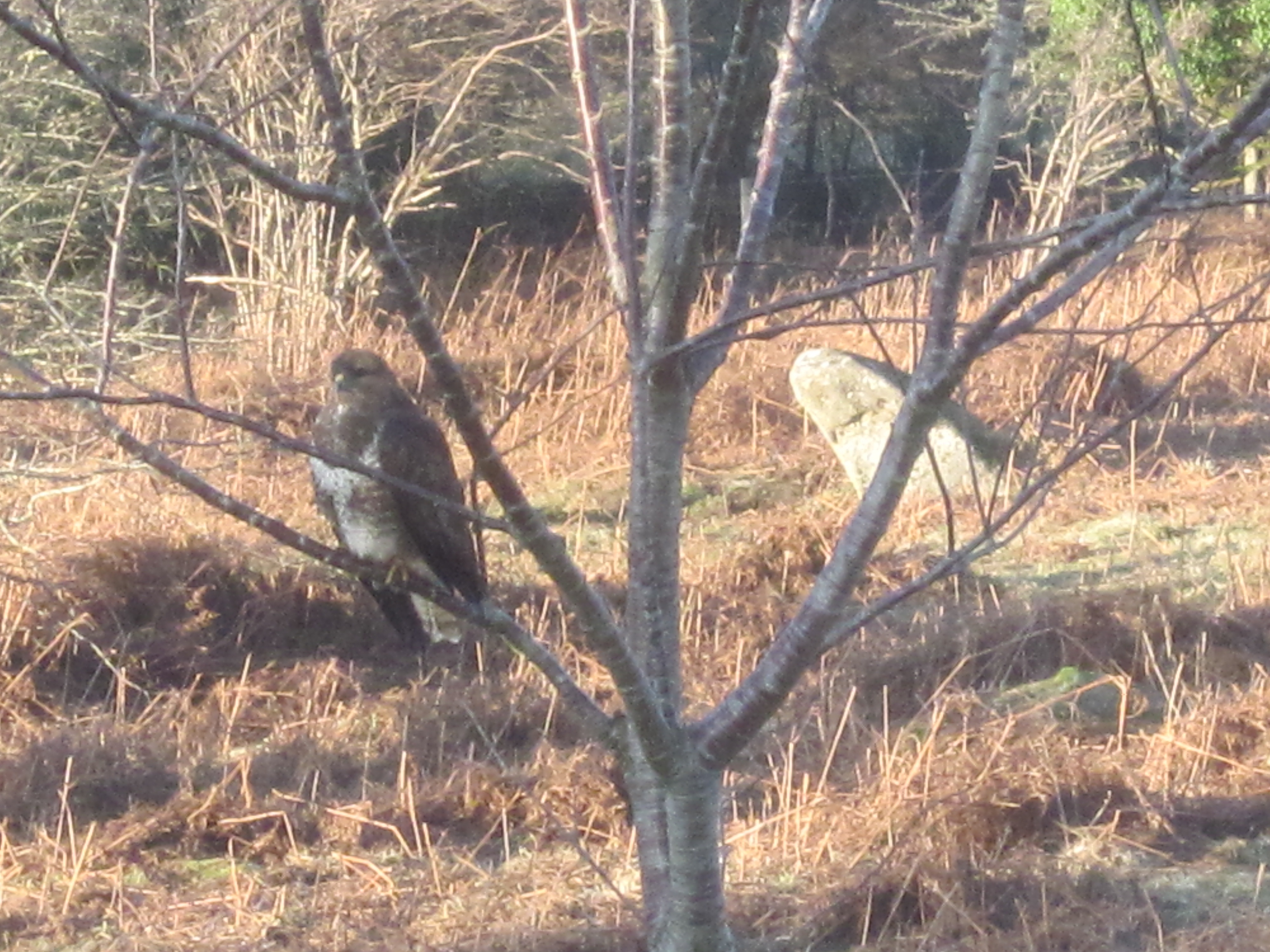
Back last September, I spent an extraordinary half-an-hour in the close company of a buzzard in the wood (Another Close Encounter).  Unfortunately, on that occasion, I had no camera on me, and the moment was too special to waste on going back to the house for one.

This afternoon, at about 16.00, in the late afternoon sun on a very cold day, I espied a buzzard on a perch where I’d not seen one before – a cherry tree about 20m from the house.  I watched it for over a minute before it ambled off. Excuse the quality of the photos taken with my little Canon Ixus – it was on maximum zoom (x16) from behind a window.

They’re much bigger birds when perched than they look when riding the thermals.  That said, look at the wingspan on this buzzard as it took flight away from the camera, tail feathers spread and talons down!

• Sharp Tor in early-morning light

Returning from Minions with the paper, I caught this unusually lit view of Sharptor.

IMG_5261 copy

• Ah! New neighbour

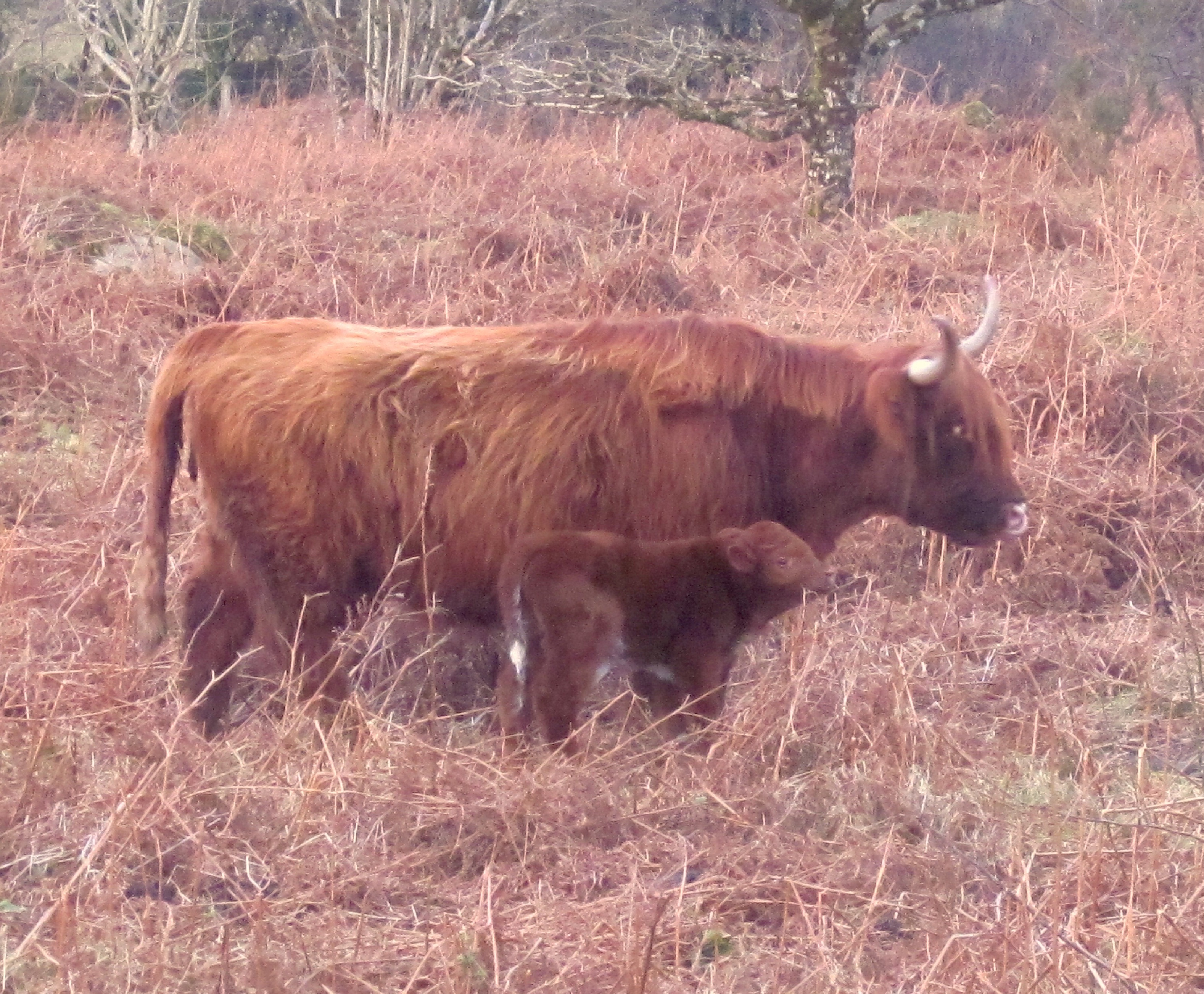
Late yesterday afternoon, I spotted this pair from my kitchen window.  It looked as if the calf had been born just an hour or so earlier – the mother was still cleaning it (she’s still licking her lips in this shot) and it had taken its first feed (from the other side, unfortunately!).  It could already walk and the pair refused to stand still for the camera, so it’s a bit blurred from a distance of 50 metres.  Cute, though.

• Good Day Sunshine

Shamelessly borrowing the title of one of my favourite Beatles’ songs, here’s a photo I took early this morning on my way back from fetching the Sunday paper.

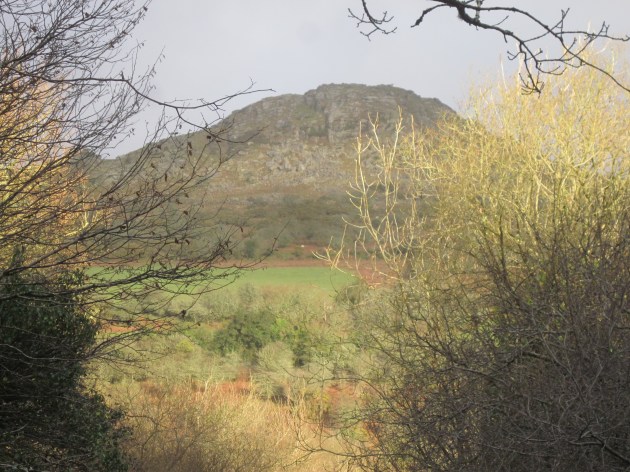
This view never fails to cheer me – it’s my local equivalent of Cézanne’s Mont Saint-Victoire, or so I like to think.  It’s never fully in view and in the spring it is garlanded by a foreground of light green foliage.  In winter, the trees provide a thicket of wild branches and twigs.  On this rare sunny day in January (it’s been a wet and stormy start to 2012), the distant greens, oranges and greys basked in an extraordinary glow.  There was even a buzzard circling, although at the moment I took the shot it flew behind one of the left-side twigs.

• Is grey-green the new sepia?

Yesterday, in the local arts centre, I caught up with the most recent Jane Eyre (Cary Fukunaga, 2011).  As The Guardian critic Peter Bradshaw put it, it’s ‘cool, temperate’ and understated (except in the overlong opening – and recapitulated – storm-flight sequence).  Mia Wasikowska and Michael Fassbender are credible in age and empathy, though the edginess between them is less pointed than in previous versions (maybe that’s to the good).  It’s beautifully shot, and that led me to ponder on colour tinting in recent period films.

I’m not a film buff nor do I have any technical knowledge, but I’m struck by the overwhelmingly grey-green palette not only of this Jane Eyre but also the three-part BBC TV adaptation of Great Expectations (Brian Kirk, 2011) that went out between Christmas and New Year.  The outdoor visuals were stunning in both, but those in Great Expectations were outstanding: the marshes, the Thames, the London streets.  In Jane Eyre they were picturesque rather than threatening (rather like the film itself), while in Great Expectations the tension was ratcheted up by the half-lights.  In both films, facial expression was often more telling than the spoken word.  In Great Expectations, young Pip (Oscar Kennedy) was extraordinarily powerful in this regard.

Why this muted colour trend, if it is one?  It appears to be reaching for some imagined period authenticity, as if viewed through gauze (I think ‘scrim’ is the technical term).

Is grey-green the new sepia, an automatic ageing device, giving a mixture of distance and comfort?  It’s hard to believe that life in 19th-century Britain was so lacking in saturated colours.

The poster montage for Great Expectations, for example, implies that the film is the equivalent of old-fashioned, colour-tinted black-and-white photos.  To a large extent it is, yet somehow it doesn’t seem dated.

Are we, perhaps, heading towards the return of black-and-white movies, even silent ones?  The Artist (Michel Hazanavicius, 2011) suggests that this might be so.  I hope it reaches these here parts soon!

• Eyeball Massage

During a brief trip to London last week, I was persuaded to go to see an exhibition at the Hayward Gallery.  I say ‘persuaded’ because the advance publicity for this exhibition of video work by the Swiss artist Pipilotti Rist hadn’t really lit my fire.  It turned out to be fascinating, funny and moving.  Part of the fun was watching the reactions and movement of other visitors.

There were the ‘lie down and absorb’ sections, the better of which was ‘Administrating Eternity’ (2011), where two different videos were projected onto and through series of see-through veils hanging from the ceiling.  Visitors were encouraged to lie on the floor, resting on cushions shaped like torsos or snuggling their heads in the crotch of a pair of stuffed legs.  Atmospheric music (that sounds awful, but it worked) supported the ‘eyeball massage’ of the exhibition’s title.  Viewing the images from the sides and from behind brought ever new perspectives.  It was unexpectedly impressive.  A still image gives only a glimpse of its qualities.

It’s hard to describe ‘A Peak into The West …’ (1992/2011) and its video ‘I’m Not The Girl Who Misses Much’ (1986). The former is a huge elongated horizontal pyramid made of wood which sticks, point out, into the room.  In its underside are cut several football-sized holes and visitors can’t resist crouching down to pop their heads up into the interior space.  This act itself is performance art for those standing nearby.  What you see inside is the somewhat manic video ‘I’m Not The Girl …’, where Rist dances half naked, singing the title, which is based on The Beatles’ Happiness is a Warm Gun.  All components – image, sound, colour – are distorted, rather like the actions and posture of the viewers, who giggle uncontrollably at seeing just fellow heads poking up through the floor of the pyramid.

Another viewer contortion is inevitable if you’re to see the tiniest video, ‘Selfless In The Bath Of Lava’ (1994).  Blink and you miss it unless you hear the sound coming from beneath your feet.  Inset in the floor is a video window barely bigger than a £2 coin.  If you get down on your hands and knees, you can see a woman writhing in red-hot lava, asking for forgiveness in four different languages (English, French, German and Italian): ‘I am a worm and you, you are a flower.  You would have done everything better.  Help me.  Forgive me.’  Somehow, Rist persuaded me that I was looking at something real, crying out from one of Dante’s circles of hell far below.

Among the other exhibits, I particularly liked the miniature models with in-built videos, like ‘Your Space-Capsule’ (2006), or not-so-miniature objects such ‘The Little Circle’ (1993), with its video ‘Pimple Porno’ (1992), where images of sexual activity are viewed inside a giant red model of a virus sitting inside a baby’s cot.  Some of the items are more modest, but equally telling, like ‘Sparking Of the Domesticated Synapses’ (2010), with its video – projected from inside a watering can onto a vase – of a woman’s hands working with flowers.

The exhibition continues until 8 January 2012.

• Prince of Wales mine (halo)

Another shot taken on my early-morning walks for the paper.

IMG_5128 copy

• The Painter and his Bus (1961)

Only after I posted yesterday about Szpilman and his cheerful 1952 song The Red Bus did I remember a quite different ‘bus’ altogether.  When I was a student in Poland 40 years ago, I went to the National Museum in Warsaw and was bowled over by one particular painting, completed ten years earlier.  I bought a glossy black-and-white photo of it and put it up on the wall of my room.  I still have it.  It’s pretty gruesome and certainly intended to disturb, so why did I want to look at it every day?  It was because its subject matter still resonated and illuminated my first experiences of Poland.

Szpilman’s music and Kazimierz Winkler’s lyrics had painted a sunny picture of Warsaw under reconstruction in the early 1950s.  Such songs were intended to encourage Poles to look to a bright socialist future under the ‘benign’ gaze of Poland’s eastern neighbour, the USSR, and its leader, Comrade Józef Stalin.  The following year, Stalin died and the later 50s were witness to upheavals in East Germany, Poland and, bloodiest of all, Hungary.  Even the Soviet Union changed somewhat.

Creative artists felt that there were now possibilities for greater freedom (this varied wildly from country to country behind the ‘Iron Curtain’) as well as for criticism and satire of the authorities and their dogmas about the ‘bright future’. One of these artists was the Polish painter, Bronisław Wojciech Linke (1906-62).  Towards the end of his life, 50 years ago, he created his masterpiece, Autobus (1959-61).

Polish buses were still crowded and rickety in the early 1970s, but I never encountered one quite like this.  Linke’s pessimistic, dehumanised vision may seem nightmarish to us, but to its contemporary viewers its metaphors were all too real.  They knew these characters, these distortions, this life.

Within this cut-away red bus are symbols of a broken and divided society. From left to right, they include:

• the Driver, a mannequin made of wood grasping a cobwebbed driving wheel
• the Jew, facing away
• the Polish Army Soldier, helmet in his hands, standing next to a figure with a giant lemon for a head
• the gormless Worker making a common and rude gesture
• the Cosmonaut
• the trendy (= scruffy) Young Man with his gloved girl and her silver handbag, sitting on a missile
• the greedy Priest, with coins for eyes
• a naked Young Girl on her naked mother’s lap
• the faceless (in fact, bodiless) Bureaucrat, sitting neatly on a pile of paper
• the lecherous Old Man with the naked doll
• the Drunk in his czapka krakuska (Kraków cap) and white overcoat, his body a giant bottle of spiritus
• the queuing Woman, clutching a large loaf and bags of shopping
• and, last but not least, Generalissimus Stalin himself, with a prison window for a heart.

Most of them have their eyes shut.  And among them are ghoulish faces, a newspaper that screams with raised arms and clenched fists, pierced by the passengers’ handrail, and a gigantic beetle.  I can’t claim to have picked up all the references (any further observations gratefully received!), but its imagery remains as powerful as it did for me in 1971.

There is not much on this penetrating artist on the web, but the following links may be helpful:

http://polish-art.info/linke.html (some further images)
• http://englishwarsaw.blogspot.com/2011/02/on-bus-bronisaw-wojciech-linke.html  This is a blog entry (25.02.11) by ‘Pan Steeva’, with more Linke images interlacing his translation of the Polish Wikipedia article on the painter.
http://www.youtube.com/watch?v=Ms5Y0cDJ-3A  This is a strange concoction uploaded only last week.  It’s a freeze-frame download from a Polish TV ‘Kultura’ profile of Autobus made in 1998.  The commentary by the distinguished painter and graphic artist Franciszek Starowieyski (whose art has clear connections with Linke and whose posters had an even stronger impact on me in the early 70s) is discarded in favour of a performance of a Scarlatti sonata …  But this YouTube video, ‘Autobus.wmv’ (3’32”), does give some valuable close-ups of the picture.

See also my subsequent post about Jacek Kaczmarski’s powerful song Czerwony autobus (7.12.11) and another giving its Polish lyrics and an English translation (13.12.11), both with a YouTube audio link.