• Conundrum – When Does A Shower Become Rain?

Yesterday at 06.30, BBC Radio’s weather forecasters predicted “showers in the West”.  It then proceeded to rain solidly – and heavily – for three hours.

So when does a shower become rain?

I’d like to think that there’s Zen-like enlightenment to be found in that elusive moment of transition.

• John Clare’s ‘August’

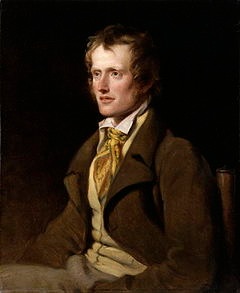
John Clare’s The Shepherd’s Calendar (1827) is a constant source of delight.  His eye for detail and linguistic turns of phrase constantly surprise.  I’m very fond of this episode from ‘August’, where ‘the bawling boy’ goes stealing fruit under the cover of darkness.  As I frequently walk home at night, with unexpected animal and bird noises and looming shapes on all sides, I can identify with the boy’s alarm!

When day declines and labour meets repose
The bawling boy his evening journey goes
At toils unwearied call the first and last
He drives his horses to their nights repast
In dewey close or meadow to sojourn
And often ventures on his still return
Oer garden pales or orchard walls to hie
When sleeps safe key hath locked up dangers eye
All but the mastiff watching in the dark
Who snufts and knows him and forbears to bark
With fearful haste he climbs each loaded tree
And picks for prizes which the ripest be
Pears plumbs or filberts covered oer in leams
While the pale moon creeps high in peaceful dreams
And oer his harvest theft in jealous light
Fills empty shadows with the power to fright
And owlet screaming as it bounces nigh
That from some barn hole pops and hurries bye
Scard the cat upon her nightly watch
For rats that come for dew upon the thatch
He hears the noise and trembling to escape
While every object grows a dismal shape
Drops from the tree in fancys swiftest dread
By ghosts pursued and scampers home to bed
Quick tumbling oer the mossy mouldering wall
And looses half his booty in the fall
Where soon as ere the morning opes its eyes
The restless hogs will happen on the prize
And crump adown the mellow and the green
And makes all seem as nothing ne’er had been


• Trethevy Quoit

A little howse raised of mightie stones (John Norden, 1584)

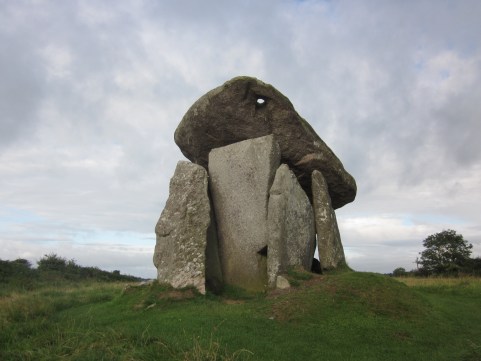
The early morning sun drew me away from my study and out again for a good three-hour walk along the fringes of the moor.  Destination: Trethevy Quoit, near St Cleer, aiming to be back by 10.00 before the predicted heavy rain materialised.  Success on all accounts!  I’ve seen and marvelled at quoits in West Cornwall, particularly Zennor Quoit, near where the painters Bryan Wynter and Patrick Heron once lived and near where I had productive composing retreats in the 1980s.  But Trethevy Quoit is something else.

It’s massive.  It has crazy angles, a mysterious hole in the ‘roof‘ and a puzzling neolithic version of a cat-flap at the SE end.  Shame about the unlovely houses next door.  Even so, it’s spectacular.  Whatever you think of the claims for its solar alignment, potential for astronomical observation and other speculations about its intended structure and usage, it remains an awesome monument to ancient endeavour and societal honour.

And there are great views.  To the W: the tall tower of St Cleer parish church.  From the N to the E: engine-house chimneys and other evidence of the copper-mining boom of the mid-late 19th century.  Today, it’s quiet, apart from the excited twittering of a charm of goldfinches feasting on thistle seeds.  Back then, Trethevy Quoit must have seemed a bizarre, silent relic beyond which all hell was breaking loose.  No-one has quite caught the contrast between Trethevy Quoit and the South Caradon mine better than the author Wilkie Collins in this well-known passage from Rambles Beyond Railways: Notes in Cornwall Taken A-Foot (1851):

… about a mile and a half from St. Clare’s Well, we stopped to look at one of the most perfect and remarkable of ancient British monuments in Cornwall.  It is called Trevethey Stone, and consists of six large upright slabs of granite, overlaid by a seventh, which covers them in the form of a rude, slanting roof.  These slabs are so irregular in form as to look quite unhewn.  They all vary in size and thickness.  The whole structure rises to a height, probably, of fourteen feet; and, standing as it does on elevated ground, in a barren country, with no stones of a similar kind erected near it, presents an appearance of rugged grandeur and aboriginal simplicity, which renders it an impressive, almost startling object to look on.  Antiquaries have discovered that its name signifies The Place of Graves; and have discovered no more.  No inscription appears on it; the date of its erection is lost in the darkest of the dark periods of English history.

Our path had been gradually rising all the way from St. Clare’s Well; and, when we left Trevethey Stone, we still continued to ascend, proceeding along the tram-way leading to the Caraton Mine.  Soon the scene presented another abrupt and extraordinary change.  We had been walking hitherto amid almost invariable silence and solitude; but now, with each succeeding minute, strange, mingled, unintermitting noises began to grow louder and louder around us.  We followed a sharp curve in the tram-way, and immediately found ourselves saluted by an entirely new prospect, and surrounded by an utterly bewildering noise.  All about us monstrous wheels were turning slowly; machinery was clanking and groaning in the hoarsest discords; invisible waters were pouring onwards with a rushing sound; high above our heads, on skeleton platforms, iron chairs clattered fast and fiercely over iron pulleys, and huge steam pumps puffed and gasped, and slowly raised and depressed their heavy black beams of wood.  Far beneath the embankment on which we stood, men, women, and children were breaking and washing ore in a perfect marsh of copper-coloured mud and copper-coloured water.  We had penetrated to the very centre of the noise, the bustle, and the population on the surface of a great mine.

Here’s a more recent response to the ‘startling object’.  It’s by Charles Causley, born this day in 1917, in his poem ‘Trethevy Quoit’ (Field of Vision, 1988):

Sea to the north, the south.
At the moor’s crown
Thin field, hard-won, turns on
The puzzle of stones.
Lying in dreamtime here
Knees dragged to chin,
With dagger, food and drink –
Who was that one?

None shall know, says bully blackbird.
None.

Field threaded with flowers
Cools in lost sun.
Under furze bank, yarrow
Sinks the drowned mine.
By spoil dump and bothy
Down the moor spine
Hear long-vanished voices
Falling again.

Now they are all gone, says bully blackbird.
All gone.

Hedgebirds loose on wild air
Their dole of song.
From churchtown the tractor
Stammers.  Is dumb.
In the wilderness house
Of granite, thorn,
Ask where are those who came.
Ask why we come.

Home, says bully blackbird.
Where is home? 

• The Cello in Art (5) – Jacek Malczewski

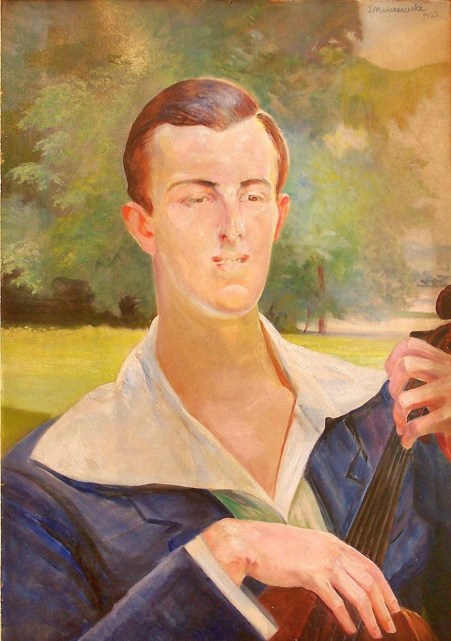
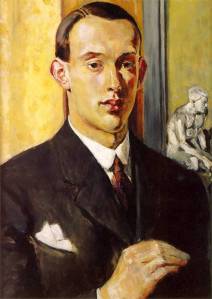
This is probably a less familiar image than the previous one by Augustus John, and there’s less evidence of a cello!  In Portrait of a Man with Cello (1923), the Polish painter Jacek Malczewski (1854-1929) depicts the young man strumming the instrument like an upright guitar or a lowered violin.  His languorous manner, slicked-back hair and exaggeratedly broad shirt collar, combined with the landscape, suggest nothing less than a weekend in the country along with a spot of music-making, don’t-ya-know.  To my untrained eye, the man bears a striking resemblance to a previous portrait that Malczewski had made of his son Rafał (below).  (Rafał also made a career as a painter, but he is best remembered as one of Poland’s most distinguished skiers and mountain-climbers.  In 1917, he narrowly escaped death in the Polish Tatras.  This portrait dates from that year.)

Earlier in his career, Jacek Malczewski had taken up Symbolism with a vengeance, and it is in this period that his most famous paintings were created.  He was best known for his forthright portraits, but rare are those without other allegorical ‘presences’ counterpointing, peering over the shoulder of or threatening the subject.  The most common ‘onlookers’ are chimeras (in Malczewski’s case, winged females with huge-thighed limbs and a lion’s claws), fauns and muses.

There is a number of portraits with musical themes and several of these reveal their folk origins by the inclusion of the narrow fiddle known as a gęśl.  Below are three such paintings: Self-Portrait with Fiddle (c.1908), Music (1908) and Shepherd Boy and Chimera (1905).

• Reclaiming Heligan

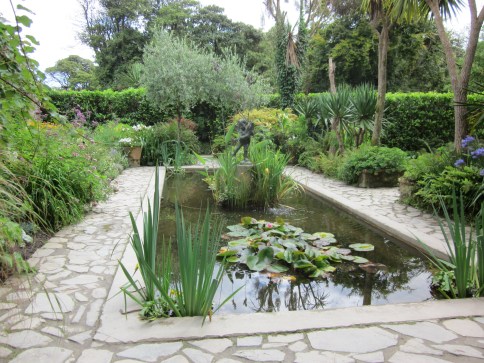
An unpromising early weather forecast yesterday didn’t deter us from making an excursion to The Lost Gardens of Heligan.  Pouring rain en route was not encouraging.  On arrival, it seemed wise to take the opportunity to have a coffee-break with the few other visitors who had braved the elements.  But the forecast was right – it cleared up.  Yet the gardens remained virtually deserted.  We had the Northern Summerhouse to ourselves (rain-soaked views to the sea) and even, an hour or so later, the Italian Garden (above).  These two spots are particularly atmospheric, fit for contemplation from their open-fronted summerhouses.  Yesterday, this really was possible.

 Why, at the height of the tourist season, were there so few visitors?  I hope that it wasn’t a result of the appallingly feeble BBC2 documentary last Wednesday (produced and narrated by Philippa Forrester).  I’ve been to Heligan over half-a-dozen times in the last couple of years and have been continually amazed by its variety, its surprises, its seasonal beauty, the vigour of its spirit, the rigour of its restoration and the dedicated discipline of its workforce.  Its magic lies, I think, in the unusual combination of man-made structures with both tamed and untamed nature.  The last thing it needed was some slack TV team making a twee, toothless travesty of a nature programme about it.

Natural World: Heligan – Secrets of a Lost Garden (no secrets were revealed) was soft-focus, slow-motion and hugely overextended (its hour’s content could have been contained in a programme a third of its length).  It did Heligan no service and, a few episodes of mildly interesting visuals aside (mating toads, seaweed gathering), added nothing to existing widespread knowledge of the place nor of the lives of the few animal species upon which it set its blinkered gaze.

When you go to the Hide, for example, you’ll see Heligan’s own films of its wildlife that knock spots off the BBC’s.  The programme’s music tracks were almost uniformly distracting and inappropriate, with the saccharine tone of the spoken commentary seemingly about to break into the phrase “This is not just Heligan.  This is Your Heligan”.  And who is it with two brain cells who can’t see through the ludicrously anthropomorphised text and visuals concerning the death of a young fox or the Great Spotted Woodpeckers, which we were supposed to believe might be laying a few extra eggs especially so that Nice Mr Grey Squirrel could have a few?  Surely the world and the rest of the BBC have long moved on from (the inimitable) Beatrix Potter when it comes to discussing wildlife.  Not even the coverage of the restoration of Heligan came anywhere near adequate.  It was just plain lazy.

So, if you haven’t already been to Heligan, go soon, no matter what the weather, walk the grounds and reclaim its history and marvel at its living character.  You’ll find it an infinitely more intense, real and fascinating experience than this low-grade gift-shop souvenir would have you believe.

• O’er Moor and Vale

A horse, a horse?  Mark him down for a horse!

We did wonder what Dalmatians and Gloucestershire Old Spots might think.  This was just one sight on a four-hour walk across the moor yesterday afternoon in perfect walking weather – breezy, pleasantly warm, and nobody about.

Our trek took in Hawk’s Tor, with its extraordinary linear cliffs and eroded cheesewrings, Trewortha Tor, with its Easter Bunny, King Arthur’s bed (damned uncomfortable and would give you a wet bottom), Kilmar Tor and Bearah Tor, with clear views of Dartmoor.  Below Kilmar is this cist, a 3’-deep burial chamber surrounded by tooth-like protective stones and originally covered in a mound of earth.  You have to search to find the cairn, but it’s worth it when you do.

• This Turning Tree

For some reason, a poem by Charles Causley sprang to mind today.  He lived less than ten miles from where I do now, but he died in 2003, before I moved back to Cornwall.  A good few years ago, I composed a song on his verse, this turning tree, and the MS is still languishing somewhere in a trunk of like-fated pieces!  I was taken by its subject matter – the death of a sailor – not least because one of my great-great-grandfathers, a master mariner and captain of a ship that sailed out of St Ives to and from the Mediterranean and Black Sea, died on a voyage off Salonika.  More particularly, I was captivated by Causley’s gnarled language and terse syntax.

Grave by the Sea

By the crunching, Cornish sea
Walk the man and walk the lover,
Innocent as fish that fare
In the high and hooking air,
And their deaths discover.

Beneath, you said, this turning tree,
With granite eye and stare of sand,
His heart as candid as the clay,
A seaman from the stropping bay
Took to the land.

Once this calmed, crystal hand was free
And rang the changes of the heart:
Love, like his life, a world wherein
The white-worm sin wandered not in.
Death played no part.

Wreathed, and with ringing fingers he
Passed like a prince upon the day
And from its four and twenty towers
Shot with his shaft the haggard hours,
Hauled them away.

So he set from the shaken quay
His foot upon the ocean floor
And from the wanting water’s teeth
The ice-faced gods above, beneath,
Spat him ashore.

Now in the speaking of the sea
He waits under this written stone,
And kneeling at his freezing frame
I scrub my eyes to see his name

And read my own.

• Sit, Stand, Walk

Yesterday, I got in from a convivial evening with friends at the Rising Sun near Altarnun just in time to catch Radio 3’s late-night Hear And Now, a broadcast of a brilliant concert from this year’s Spitalfields Festival.  It was given by Chroma and featured works by Param Vir (Hayagriva) and Jonathan Harvey (Sringara Chaconne).  But for me the highlights were two works by Rolf Hind: Horse Sacrifice (2001) and the premiere of Sit, Stand, Walk (2011).

photo: Alys Tomlinson

I should declare an interest here: Rolf spent nine days in Cornwall in July 2010, meditating intensely indoors and outdoors (though not on a deckchair, as I recall).  More importantly, he composed one of the movements of Sit, Stand, Walk in my music room.  His stay has spurred me on to get quotes for converting the garage into a proper studio where artists of any discipline can come and be creative away from their normal hustle and bustle.

I first met Rolf when he came to give a recital at Queen’s University, Belfast, in the mid-1980s.  I’ve never forgotten his stunning performances of Beethoven, Copland and Carter sonatas that evening.  Few pianists can match his total dedication to new music and it’s no wonder that composers specifically ask to work with him, knowing that he’ll get to the heart of their music, both interpretatively and technically.  So it’s great that the tables are now turning and performers are asking to work on his own growing output as a composer.

He has a distinctive voice that comes in large part, I suspect, from the tough demands that he makes on himself in his Buddhist meditation.  He also has an acute ear for the delicate balance of musical continuities and discontinuities, for ritual and for unusual instrumental sonorities and combinations.  The solo-ensemble drama of Horse Sacrifice played out like a miniature concerto, deft, expressive and perfectly formed, with a particularly atmospheric final movement.

Ten years on, Sit, Stand, Walk revisits the concerto principle, this time with the clarinet (a virtuosic performance from Stewart King) as protagonist.  This was even more like a journey of the soul, revealing the interior through tender antiphony (or antiphonal tenderness?) between the soloist and the slowly-gathering reflectors of the other instruments.  The ritualistic punctuation of the percussion was offset by unexpected colours, especially that of the accordion, which whetted the appetite for Rolf’s forthcoming accordion concerto (for James Crabb and the BBCSO).  This was a haunting exploration of the experience of meditation, completed by a brief fourth movement ‘Open’, which the composer rightly called ‘an exponential explosion of joy’.  A great piece and a fascinating concert of meditation-inspired pieces, though perhaps before midnight on a Saturday was not the most ideal placing!

• Words

Whenever I find myself in need of a good dictionary – and this happens all too often – I remember that one of my favourite poets, Edward Thomas (1878-1917), wrote a poem with such a spring in its step that it never fails to remind me that sometimes I should let the right word instead ‘choose me’, as Thomas memorably puts it.  So here are the final eight lines of Words (1915), briefer than brief, but more eloquent than many a long verse:

Let me sometimes dance
With you,
Or climb
Or stand perchance
In ecstasy,
Fixed and free
In a rhyme,
Like poets do.

After my current writing project I’m going to sequester myself with two books by and about Thomas that I’ve been really looking forward to reading: Thomas’s account of his journey through the English countryside in The South Country (1909, republished 2009) and Matthew Hollis’s just-released biography of Thomas’s last years, Now All Roads Lead to France.  By all accounts, Hollis brings his poet’s insight and a penetrating eye to this extraordinarily raw episode in English literature.

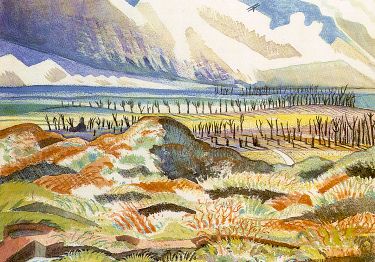
Paul Nash: Ruined Country (1918)

• Wise Old Toad

I started a blog last year and then had second thoughts.  But last night ‘Old Toad’ came to my rescue when my iWeb pages refused to appear on my screen and I thought that I’d lost the site forever.  So I’ve decided to give my idle thoughts another go, if only to thank him.  Methinks I might persevere this time.

So, along came ‘Old Toad’ of Toad Hall, Temecula, CA, with sage advice.  Hey presto!  The website was re-activated and the pages were back.  I can’t thank ‘Old Toad’ enough – he’s one of life’s good guys as he’s clearly helped thousands of other stranded/confused/desperate non-techies on the Apple Support Communities, like me, to get back on our web(bed) feet (sorry!).

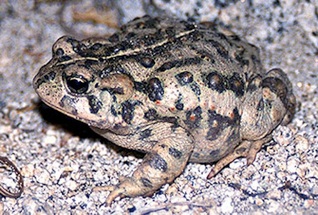
As a small token of my appreciation, here’s a photo of Anaxyrus boreas halophilus – the California Toad.  Thanks ‘OT’!