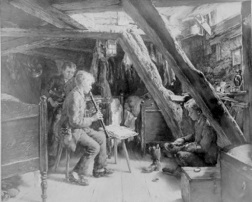
Here’s an artist completely new to me. Otto Piltz (1846-1910) was born in Thüringen in central Germany and lived at various times in Weimar and Munich. Some of his work is rather sentimental in tone and subject matter, but he was evidently interested in musical topics. He spent time during 1888-98 at his sister’s house in Sömmerda in rural Thüringen where there was a music school. Some of his depictions of the students rehearsing in attics and quiet corners – familiar to anyone who’s been at a full-time or summer music school! – are reproduced below. There’s also a painting of a church choir rehearsal.
Quintet is the best-known of these works, although it currently languishes in the vaults of the Victoria & Albert Museum in London. Dated between 1888 and the early 1890s, it has various titles, including Quintette der Gehilfen des Stadtpfiefers (there is a trombone hanging on the rear wall). The poor domestic interior is typical of such group pictures and belongs to the same European genre that gave rise to the much more visceral The Potato Eaters, which Van Gogh painted a few years earlier.
In Piltz’s painting, the five young musicians are gathered in time-honoured fashion around a table on which lie their individual parts (some propped up). They seem fairly well dressed. The near violinist (who perhaps looks older than the others) is sitting on a slatted wooden bench and there is a bed behind the cellist. The lamp is not lit, so they are reliant on the dim light coming from the deeply recessed window. It’s not a standard string quintet line-up (usually 2 violins, 2 violas and cello or 2 violins, viola and 2 cellos). The presence of the double-bass implies activities connected with civic occasions rather than concert repertoire. It’s not possible to be certain if there are 3 violins or 2 violins and viola because of the gloom. The players, however, look rather content. They certainly look more lively, musically, than the cellists in the near-contemporaneous pictures by Eakins and Hammershoi that I posted 11 days ago.
A variety of searches has led to today’s seasonal post. Following up last month’s excerpt from John Clare’s A Shepherd’s Calendar (about a boy nicking fruit from orchards in the dead of night) and thinking about Eddie Condon’s career after recording The Minor Drag with Fats Waller, I’ve come up with this.
Consider the situation. You’ve been asked to put together a new Encyclopaedia of Music with some crusty old professors. Then someone tells you that there’s a new type of music that you must include in the book. But you know nothing about it. What do you do? Simple. Get involved with an attractive young night-club singer who knows about such things and who’s wanted by the police about her gangster boyfriend. Of course, you must invite some of the practitioners of this new-fangled music to play some of it for you. Imagine Grove 6 inviting the Sex Pistols around for tea and crumpet.
Then you film the results for international distribution. Absurd? Well, it’s been done. Danny Kaye (Professor Hobart Frisbee!) and Virginia Mayo (Honey Swanson) are the acting stars in A Song Is Born (Howard Hawks, 1948). And the musicians? None other than Louis Armstrong, Tommy Dorsey, Lionel Hampton, Mel Powell and Benny Goodman (‘disguised’ as Professor Magenbruch).
These last three star in the scene above (with the other two contributing to the introductory dialogue), rather archly set-up and hammed it’s true (watch the stop-time …), but it’s a brilliant performance of Fats Waller’s song Stealin’ Apples (1936). There’s some great playing by Powell on piano and especially by Hampton on vibes. It fair jingles along.
There are many other performances out there of this song.
• Benny Goodman’s performance in Los Angeles in 1961 of Fletcher Henderson’s 1936 arrangement is smooth, zippy, though the sound quality is poor in places; there are also some interesting audience shots <http://www.youtube.com/watch?v=evS47squKmM>
• Eddie Condon recorded it a year later in a TV studio with his All Stars septet, giving even greater prominence to the clarinettist (Peanuts Hucko) than in the other two videos <http://www.youtube.com/watch?v=1NKFEm9Qd1w>.
Thanks to enquiries made by Nancy Giffin, Bill Haesler and Adrian Ford, it’s also possible to bring you Andy Razaf’s lyrics, although it appears that Stealin’ Apples has never been recorded in its song form.
I was always taught that it was wrong to be a thief.
He who took his neighbour’s good would surely come to grief.
There’s exceptions to the tune I guess,
What I used to take brought happiness.
Apple time was always time for stealin’,
Just to be with you was so appealin’
Takin’ chances
Stealin’ apples with you.
We would wait and catch the farmer nappin’,
In his orchard anything could happen,
Takin’ chances,
Stealing apples with you
I could hardly wait until you would bite one,
For it meant a kiss if it was the right one.
What a joy dear, it would be,
If I could find myself once more back in wildwood,
Takin’ chances,
Stealin’ apples with you.
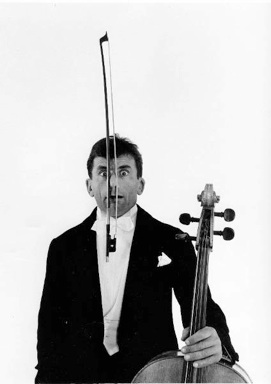
This was the first of Robert Doisneau’s photographs of Baquet that I ever saw. I bought it in a wonderful postcard shop in Tribeca, New York, some time in the 1980s. It still makes me smile!
Baquet was a remarkably versatile man. Here’s a 21” clip from a French newsreel of 1946. Paris was in deep snow and Baquet – an Olympic skier – took advantage. There are scenes of Paris streets and a view including Montmartre’s famous Moulin de la Galette (painted by many French artists and van Gogh). The newsreel finishes with Baquet skiing the broad steps in front of Sacré-Coeur and straight down a much narrower flight.
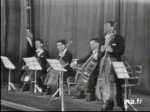
I’ve just come across another historic clip, but one which is viewable only on a French site (ina.fr). Click on the thumbnail image below. It’s a recording from what seems to be a French TV variety show and was broadcast by RTF on 12 May 1958. It’s a 6’ sketch called Le Quatuor, which comprises four cellists (not the standard quartet line-up), with the three on the left playing straight men to Baquet’s clowning. Doisneau’s image above reappears halfway through Baquet’s routine. It may seem a bit dated now, but his comedic imagination is sharply honed, as is his command of the cello. He really could play!
Following on from yesterday’s ‘What Are You Up To, Radio 3 – Essentially?’, I thought I’d point up one of the delights of ‘inessential’ revelations in Classical Collection which I caught two years ago. I think it was Rob Cowan who played Mam’zelle Clio, sung by Charles Trenet. I fell for its joie-de-vivre and humour straightaway and immediately ordered CDs and sheet music. I wasn’t disappointed. Here was a singer and composer with a very special talent to amuse, à la français, bien sûr (he was known as ‘le fou chantant’), as well as to pull on the strings of sentiment. I knew La Mer, his greatest international hit, but nothing else. Thank you, Rob Cowan. May you continue to throw unexpected, non-mainstream and ‘inessential’ items into the mix of your new programme, whatever its title.
I’m attaching two contrasting clips from a film Trenet appeared in when he was turning 30, La Cavalcade des Heures (Yvan Noé, 1943). In the first, he doesn’t sing on screen, but listens to a 78 of a song that he co-wrote and recorded a year earlier, Que reste-t-il de nos amours?. Its mood is suitably seasonal: ‘Tonight, the wind that knocks on my door/talks to me of dead loves/in front of the fire which is going out. Tonight, it’s a song of autumn/in the house that shivers/and I think of distant days. [Refrain] What is left of our loves?/What is left of those fine days?/A photo, old photo/of my youth. …’ You may recognise the melody, which was reused for I Wish You Love and recorded by Marlene Dietrich, Dean Martin, Frank Sinatra, Rod Stewart and others. But nothing beats Trenet’s understated original.
The second clip shows Trenet singing a very different song, in his trademark trilby. Débit de l’eau … Débit de lait is one of his most popular in France, mainly because of its clever and delightfully whimsical lyrics and tongue-twisting patter. The refrain includes lines such as:
Ah qu’il est beau, le débit de lait, Ah qu’il est laid, le débit de l’eau Débit de lait si beau, débit de l’eau si laid S’il est un débit beau, c’est bien le beau débit de lait. Au débit d’eau y a le beau Boby, Au débit d’lait y a la bell’Babée …
Here’s a resumé of the main threads of the story: two shops (débits) in the street, one ugly (laid) selling water (l’eau), one pretty (beau) selling milk (lait); Boby sells the water, Babée the milk. They don’t get on and quarrel over the churns (bidons). But they get married; Boby puts milk in his water and Babée puts water in her milk. And Boby makes sure he keeps pretty Babée’s two best churns of milk for himself (Oui mais Boby garde pour lui Les deux plus beaux bidons de lait de la Babée jolie) …
Oh dear, Auntie Beeb is at it again. She’s asking us to sit comfortably in our antimacassar Queen Anne chairs, our tooth mug by our side and a cup of … well, you get the picture. Welcome to Radio 3’s new morning ‘not-drive-time’ replacement for Classical Collection. With its aura of chocolate boxes and nice gift shops, that title wasn’t much to shout about either. Now, make way for … (‘Drumroll’, among other symphonies) … Essential Classics.
What a stroke of genius. It’s fresh, original, unforgettable. Others will soon catch on, mind. I can see the future: fascinating CDs and downloads called Essential Vivaldi, Essential Mozart, Essential Mendelssohn. We might even get, wait for it, Essential Ravel or Essential, Essential Classics. And, dare I think the unthinkable? How about Essential World Music or Essential Classic Jazz (a double hit there, surely)?
Say the word over and over and it becomes meaningless. Actually, it’s pretty meaningless anyway. Essential for whom, for what? I believe that the title is nothing but a cynical ploy to be seen to try to attract less-demanding listeners. Are radio listeners that dumb? Radio 3 has a robust following, so does it think that its survival depends on some putative untapped constituency with few musical brain cells between the ears? Seriously, who these days is going to be won over by such a title? Not the younger listener, that’s for sure. In any event, I don’t think that Radio 3 really believes in titles like this. Classical Collection frequently goes beyond expectations, so why shouldn’t Essential Classics? It had jolly well better do, otherwise it will lose listeners.
There is so much twaddle that accompanies schedule changes. Radio 3 says: ‘The extended length of this programme will allow for longer pieces of repertoire to be played and will include, for example, a performance of the complete ‘Building A Library’ recommendation’. To take the latter point first: Classical Collection presents the complete ‘Building A Library’ recommendation already – so what’s new? As to ‘longer pieces of repertoire’, there are plenty of examples in recent Classical Collection playlists of works lasting 20’-30’. Less than two weeks ago, it broadcast Strauss’s An Alpine Symphony, which comes in at c. 50’. So another piece of promotional tosh.
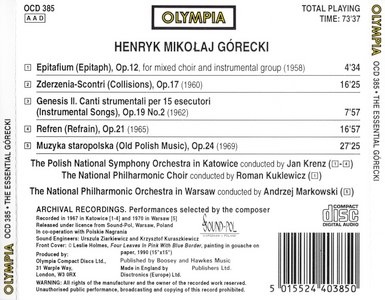
Yet there may be hope for those of us who like a challenge or something ‘inessential’ in our morning (or anytime) listening. I’m thinking of a wonderful use of my least favourite word in the marketing of an Olympia CD back in 1993. It was of music by Henryk Mikołaj Górecki (OCD 385) and was clearly piggybacking on the phenomenal international success of Elektra Nonesuch’s CD the previous year of the Pole’s Third Symphony, ‘Symphony of Sorrowful Songs’ (1976).
What better way to encourage sales than by calling the CD The Essential Górecki Orchestral and Choral Music. Recordings Selected by the Composer? Brilliant. Though I’m damn sure that Górecki didn’t choose the headline title. Pity the poor enthusiast for the Third Symphony who bought this CD expecting more of the same, because isn’t that what was being implied? If the enthusiast listened to music from the comfort of a well-upholstered and well-protected armchair, then a life-threatening shock was in store.
Why? Because the five works on The Essential Górecki were nothing like the Third Symphony. There was the terse, Webernian Epitafium (1958), the explosively avant-garde Scontri (Collisions, 1960), the gritty Genesis II (1962), the Messiaenic Refrain (1965) and the modal v. serial-atonal Old Polish Music (1969).
If, on the other hand, the listener was open-eared, unconcerned with mantras about ‘core repertoire’, a wonderful, mould-shattering surprise awaited. Because, to appropriate the word ‘essential’, this music from 1958-69 was and is representative of the composer’s creative drive and imagination and an essential component in an understanding of his musical journey.
Olympia’s marketing was either a cynical move or an inspired hijacking – of a stale, tired, forgettable term – whose subversive intention was to stimulate individual hearing buds and catch the listener unawares. If that’s what Radio 3 has in mind for Essential Classics, but isn’t telling, than hurrah for that.
The BBC Proms have come up trumps with several of this year’s new pieces. In the past ten days there have been three very different but fascinating premieres. First up was the world premiere on Monday last week (22 August) of a BBC commission, Kevin Volans’s Piano Concerto no.3 (2011), played by Barry Douglas and the BBCSO under Thomas Dausgaard. Kevin was one of my colleagues in the 1980s at Queen’s University, Belfast, and he has consistently been one of the most individual minds (musical and non-musical) that I’ve met. This sparkling new piece was typically challenging: daringly intuitive in its through-composed procedures as well as texturally captivating. Here’s a link to a recording (the mp3 files on this page are gratefully linked from 5:4 <http://5-against-4.blogspot.com/>).
Then there was Anders Hillborg’s Cold Heat (2010), which was given its UK premiere on Saturday (27 August). In the hands of the Tonhalle-Orchester Zürich, conducted by David Zinman, it was rich in saturated instrumental and harmonic colours, zinged, paused, and drove forwards in ways that reminded me of Michael Torke’s early work, like Ecstatic Orange (1984). Significantly, both of these high-energy works were influenced by rock bass riffs.
Since then it’s been Graham Fitkin Week on BBC Radio 3, occasioned by the world premiere of his Cello Concerto (2011) last night by Yo-Yo Ma. The channel does a good job in supporting a major Proms event with satellite concerts and features. So, on Monday, Yo-Yo Ma played Fitkin’s fiftieth-birthday present to him, L for cello and piano (2005), at a BBC live lunchtime recital from the Cadogan Hall. Then, on Tuesday, Fitkin appeared on In Tune and played three short piano pieces and we also heard Metal (1995), written for the RLPO for its return to the refurbished Philharmonic Hall. And after the concerto’s premiere last night, there was a pre-recorded Proms Plus Portrait offering several more pieces played by young musicians from the London Sinfonietta Academy Ensemble. This provided a useful chronological sample of Fitkin’s quite prolific output of chamber pieces: Sciosophy for two pianos, eight hands (1986), Hurl for saxophone quartet (1996) and Sinew for mixed sextet (2008).
Fitkin is best known for his use of monochrome ensembles (all-keyboard, all-saxophone, etc.) and highly motoric, driven music influenced by American minimalism and more particularly by his time studying in Holland with Louis Andriessen. Other references spring to mind: Leonard Bernstein’s rhythmic and jazz-dance idiom, the overlapping motifs in stable harmonic fields explored over 400 hundred years ago by Tallis in Spem in Alium, and, in Sinew, the unmistakeable fast melodic unisons of Messiaen’s ‘Danse de la fureur’ from Quartet for the End of Time. Here’s a glimpse of characteristic Fitkin: an excerpt from Log for six pianos (1990), in a performance given by pianocircus at Kings Place, London, on 7 February this year.
Yet, as an excerpt from another work in this concert demonstrates, there is a quieter Fitkin. The title (Line, 1991) may not be insignificant.
All this brings me to last night’s premiere, when Yo-Yo Ma was joined by the BBCSO under David Robertson. During the preceding days, the most repeated hint about the work from Fitkin had been his account of how he wanted to explore and exploit Ma’s legendary tone and command of line. So he’d asked Ma to play a long-held Bb to see how varied and expressive it could be. This idea proved to be key, in more senses than one, and was one of many unexpected aspects to this impressive concerto.
Coming in at 30’, this is a substantial piece, crafted as an unbroken single movement. When asked on In Tune if he’d listened to any other cello concertos in preparation for his own, Fitkin talked mainly about the balance between soloist and orchestra. On that score, he seems to have learned any lessons that were there to be learned. Fitkin’s residency with the RLPO in 1994-97 evidently gave him the confidence to handle varied and massed forces, and his Cello Concerto reaped these rewards. In the opening minutes, after the soloist’s initial gesture of a rising major 7th, B-Bb, the way in which the orchestra seemed to want to embrace the cello’s sustained Bb with beguiling chords and textures was magical (echoes of Schoenberg’s ‘Farben’?). Even when the texture was at its most frenzied, later in the piece, there was superb clarity.
What was immediately striking – and, insofar as I know his music, a new departure – was the prevailing lyricism of the music, recalling that famous Prom premiere 22 years ago of John Tavener’s The Protecting Veil, in which the cello soloist was Steven Isserlis. The two works are nevertheless very different in intention and character and, indeed, in orchestration (the Tavener was only for strings). While Tavener aimed for transcendence, Fitkin’s luminosity is often pained (edgy orchestral timbres play their part in this). This was no sweet lyricism, instead one which seemed to have an undertow of sadness.
Although the Cello Concerto plays without a break, there are clear expressive phases. After the opening 5’, a second, ‘lullaby’ section is initiated by two alternating chords, one major, one minor, dominated by harp sonorities. Unhappy with reaching for a ‘20th-century English pastoral’ parallel, as one or two of today’s newspaper reviews have done, I’ve been racking my brains as to why this plangent pairing of chords a minor third apart rang bells. And then it hit me: this is exactly the same chordal pattern that Busoni used in his Berceuse for piano (1909), also known in an orchestral version as Berceuse élégiaque. This work struck a chord 80 years later with John Adams, who arranged it for chamber orchestra in 1989. I’ve no idea whether my making a connection with Busoni has any relevance to what Fitkin intended, but it does at least underline the emotional undertow that I detect in his concerto.
By this stage, it becomes clear that Fitkin has thought carefully not only about the textural and timbral world of the concerto but also about the place of thematic material in his design. The cellist’s first idea, B natural rising to Bb, now continues, down a tone to Ab (the B natural and Ab each being a component of one of the ‘lullaby’ chords) and on further. This expressive motif assumes a central role in the work.
More familiar Fitkin territory appears in the main central episode, a scherzo (c.10’ in) which leads to the main climax at c.22’. This episode becomes increasingly agitated and dynamic. After some early tutti interruptions (c.14’), there is a lull, when the main motif returns. This lyrical highpoint heralds a pause in the scherzo section and the cello starts to play gliss-pizzicandi against lullaby chords. When the scherzo resumes, it becomes more frenetic and there is a trading of blows (c. 20’30”) leading to a sustained chord and a culminating sequence of some 17 chordal repetitions, the last seven of which accelerate collapse. This seems to be the moment, referred to by the composer in the pre-performance interview, when the concerto is “sliced, with a wedge driven through it about 3/4 of the way through”.
Out of this catharsis (c. 22’) comes perhaps the most affecting music, the cello keening gently on its main motif, now pointedly a semitone lower than before. There is a brief rally some 4’ later, where the intensity of the cello’s utterances seems to border on anger or bewilderment. Its final, distant pitch – Bb – is now a couple of octaves higher than it was at the start of the piece.
On In Tune, perhaps a bit reluctantly, Fitkin had named two composers whose cello concertos he had listened to when preparing to write his own: Shostakovich and, firstly, Lutosławski. Well my ears pricked up at this, so I was on the listen-out for any overt links to the Polish composer’s example (1970). And there are some.
Firstly, there is the focus on the soloist at the start and the end, both concertos involving some sense of character transition. While Lutosławski’s soloist moves from indifferente open-string D naturals to ‘triumphant’ high A naturals at the end, Fitkin’s journey is less traumatic and, though the soloist’s final note is higher than it was at the start, it’s still the same pitch. Then there is the crushing of the soloist by decisive orchestral chords and the cellist’s anguished response (compare Lutosławski’s ten chords at Fig. 133 and what follows). It is the concept of separation between soloist and orchestra, however, that is the most significant parallel with Lutosławski, even though each composer has a rather different take on what this can mean and how it can be achieved (the Lutosławski is generally grittier, less emotionally open and certainly more confrontational than the Fitkin).
Lutosławski’s soloist is an innocent abroad, afflicted by the society around him (if one’s looking for extramusical contexts, 1970 was a fraught time in Eastern Europe), who, despite his attempts at rapprochement, is hammered into the ground, only to rise apparently triumphant at the end. Fitkin’s soloist, in contrast, is a composed, self-sufficient and self-aware character. It is the orchestra which approaches him, cajoles him with beguiling chords and textures. He does go through what might be heard as a fire-and-water trial (had his key note been Eb one might be tempted to see masonic, Mozartian parallels!), but his self-determination is unshakeable. As a representative of the insignificance of man in the world (to paraphrase Fitkin), he’s remarkably assured.
In the programme note, John Fallas writes that the concerto ends ‘with the cellist once again songful and the orchestra unmoved, apparently indifferent’. If Fitkin agrees with ‘indifferent’ (I’m not sure that I do), it’s a role and structural reversal of Lutosławski’s idea. In the Pole’s concerto, the soloist’s indifferenteinstruction at the start sows the seed of conflict with the orchestra. Fitkin’s soloist, by contrast, like a magnificent sailing ship or even a tiny ketch, is more than equal to any blandishments or tests that the indifferent elements throw at him, especially with a masterly Yo-Yo Ma at the helm.
Yet I can’t help feeling that, if Lutosławski’s model for his soloist was the hero of a Greek drama or the central character in a Conrad novel, Fitkin’s model is altogether more veiled. He has talked about alienation today, about ‘following a path, often isolated, trying to hold true, sometimes failing, sometimes not’. To my ears, there was a greater sense of interdependence between soloist and orchestra than this suggests. At the Cello Concerto’s heart, I sensed a somewhat different underlying impulse, that of private tragedy, perhaps, which informed the solo part from start to finish. Maybe that is reading too much into what Fitkin says is ‘fundamentally an abstract piece of music’. In any case, I believe that this is an important and eloquent addition to the already rich repertoire of the cello concerto. Let us hope that other soloists will be queuing up to perform it.
After posting yesterday’s exuberant image, I recalled the work of the great French photographer Robert Doisneau (1912-94), one of whose close friends was the cellist, actor, singer, comedian – and alpinist, Maurice Baquet (1911-2005). Together they created a body of photographic images that are unrivalled for their whimsical take on life and performance.
To mark the centenary of their births this year and next, here’s one of my favourites, Les attentions courtesies (c.1942-48). There’s something touchingly chivalrous, if irrelevant in Baquet’s action: he gets wet for the sake of his cello, which is perfectly dry anyway (that is, if it is inside). It could be a still from a French film.
OK, I know that stretching exercises before breakfast are a good thing, but this is a bit extreme. I have no idea who this is, or whether he’s even a cellist, but he’s a welcome tonic after the po-faced players of yesterday. A jolly nude dude, no less.
I’ve been pondering whether to offer these pictures separately, but these two near-contemporaneous paintings seem to make a pair. The seriousness of both images – and their lack of animation – does neither sitter any favours. Each comes across as being set in his morose ways – glum old men of their time, perhaps (though one of them is still relatively young).
The one on the left, The Cello Player (1896), is by the American painter Thomas Eakins (1844-1916). That on the right, Cello Player (1893), is by the Danish painter Vilhelm Hammershøi, who was born twenty years after Eakins but died in the same year. While the Philadelphian Eakins was known for his portraiture, Hammershøi was not.
Eakins
The subject of The Cello Player is the German cellist, Rudolf Henning, who moved from Leipzig and settled in Philadelphia; he is pictured, in isolation, playing one of the five cello concertos by the almost completely forgotten German cellist and composer, Georg Goltermann (1824-98). Henning was just a year younger than Eakins, and when the painting was bought by the Pennsylvania Academy of the Fine Arts in 1896 the two men shared the fee, $250 apiece. Over a century later, in 2007, it was sold controversially – and secretly – for an 8-figure sum (reportedly $15-25m) in order to buy another Eakins painting, The Gross Clinic (1875). This ‘upgrading’ (or, to use the jargon, ‘deaccessioning’) caused considerable uproar. The Cello Player is no longer available for public view.
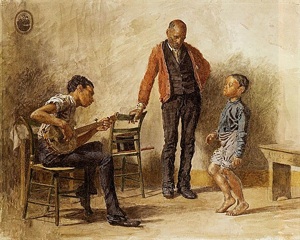
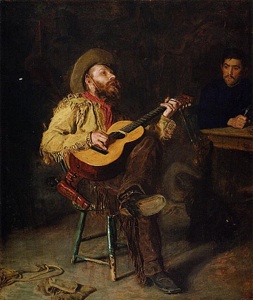
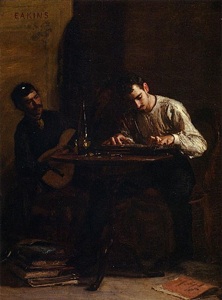
Eakins, who had the magnificent middle name ‘Cowperthwait’, depicted music and musicians on several occasions, and I’ve appended half a dozen at the end of this post. Some are depictions of performers of classical music, like The Oboe Player (1903) – a portrait of Benjamin Sharp, and Music (1904). Some are more ‘downhome’ in subject matter, like The Dancing Lesson (1878) and Home Ranch (1892). The last two portraits – The Zither Player (1876) and Professionals at Rehearsal (1883) – are especially intimate. The earlier one, in particular, has much the same air as Degas’s studies of his father listening to the guitarist and singer Lorenzo Pagans, which he painted in the 1890s. Hammershøi’s art and aesthetic could hardly be more different.
Hammershøi
As I mentioned in my first ‘The Cello in Art’ entry, on Carl Holsoe’s paintings (11 August), Hammershøi belonged to a small group of Danish painters who focused on cool interiors in which the human figure, if present, often had her (she’s usually female) back to the viewer. So the Cello Player is a most unusual topic for Hammershøi. It is a portrait of an orchestral cellist, Henry Bramsen, who was the son of Hammershøi’s greatest champion in Denmark, Alfred Bramsen. The painting was therefore a favour bordering on obligation rather than a burning artistic necessity, and that comes across in the generalised approach to most aspects of the picture, with only the instrument itself seeming to have much life or presence about it.
As examples of more characteristic Hammershøi topics, here’s Interior: With Piano and Woman in Black, Strandgade 30 (1901), which makes for an interesting comparison with Holsoe’s use of the domestic keyboard instrument in his paintings, and an exterior, Street in London (1906), a view northwards up Montague St with the British Museum on the left.
If you find these two cello players by Eakins and Hammershøi rather sombre, I’ll put up a much jollier, ‘rude’ one tomorrow, despite it being in black and white!
Well, I’m beginning to get the hang of dragging video and audio files onto these pages, so here’s the first non-YouTube audio. Fats Waller is one of my all-time favourites, partly because I’d give almost anything to be able to play stride like he does and partly because he never fails to bring a smile to my face, whether he’s singing or not.
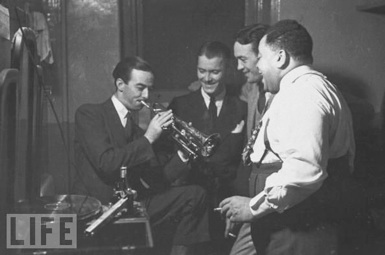
The Minor Drag is a classic example of Waller’s pianism and ensemble playing, with great contributions from the rest of the band (terrific secondary rag rhythms!). It was recorded on 1 March 1929 (St David’s Day to us Celts), with ‘His Buddies’: Charlie Gaines (trumpet), Charlie Irvis (trombone), Arville Harris (clarinet, alto and tenor sax) and Eddie Condon (banjo).
In the photo (thanks to ‘Shiraz Socialist’ for this – I’ve never come across it before), Waller’s on the right. Eddie Condon is second from left. I don’t know who the other two are – any ideas? The Minor Drag is significant because it was the first recording in which a black jazz musician had led a group which had a white player in the line-up (rather than the other way round). In fact, it is probable that Condon put this session together, as he made a point of organising racially integrated recordings. I hope it puts a spring your step as the leaves start to turn and fall this near-autumnal morning!




 After posting yesterday’s exuberant image, I recalled the work of the great French photographer Robert Doisneau (1912-94), one of whose close friends was the cellist, actor, singer, comedian – and alpinist, Maurice Baquet (1911-2005). Together they created a body of photographic images that are unrivalled for their whimsical take on life and performance.
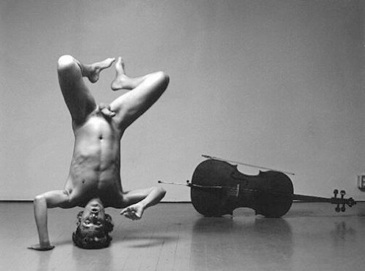 OK, I know that stretching exercises before breakfast are a good thing, but this is a bit extreme. I have no idea who this is, or whether he’s even a cellist, but he’s a welcome tonic after the po-faced players of yesterday. A jolly nude dude, no less.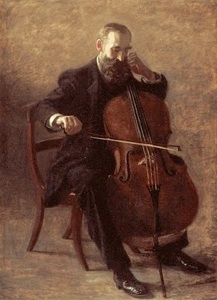
 I’ve been pondering whether to offer these pictures separately, but these two near-contemporaneous paintings seem to make a pair. The seriousness of both images – and their lack of animation – does neither sitter any favours. Each comes across as being set in his morose ways – glum old men of their time, perhaps (though one of them is still relatively young).
 As examples of more characteristic Hammershøi topics, here’s Interior: With Piano and Woman in Black, Strandgade 30 (1901), which makes for an interesting comparison with Holsoe’s use of the domestic keyboard instrument in his paintings, and an exterior, Street in London (1906), a view northwards up Montague St with the British Museum on the left.




 Cornish Adrian