• Sharp Tor in early-morning light
Sunday, 22 January 2012 Leave a comment
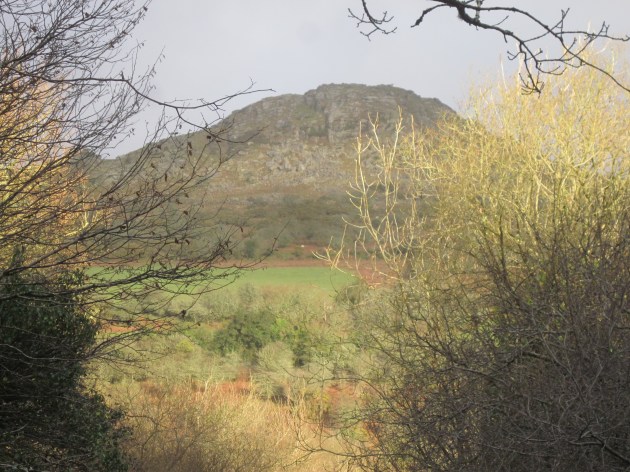
Returning from Minions with the paper, I caught this unusually lit view of Sharptor.
… on the arts and the outdoors
Sunday, 22 January 2012 Leave a comment
Returning from Minions with the paper, I caught this unusually lit view of Sharptor.
Sunday, 15 January 2012 Leave a comment
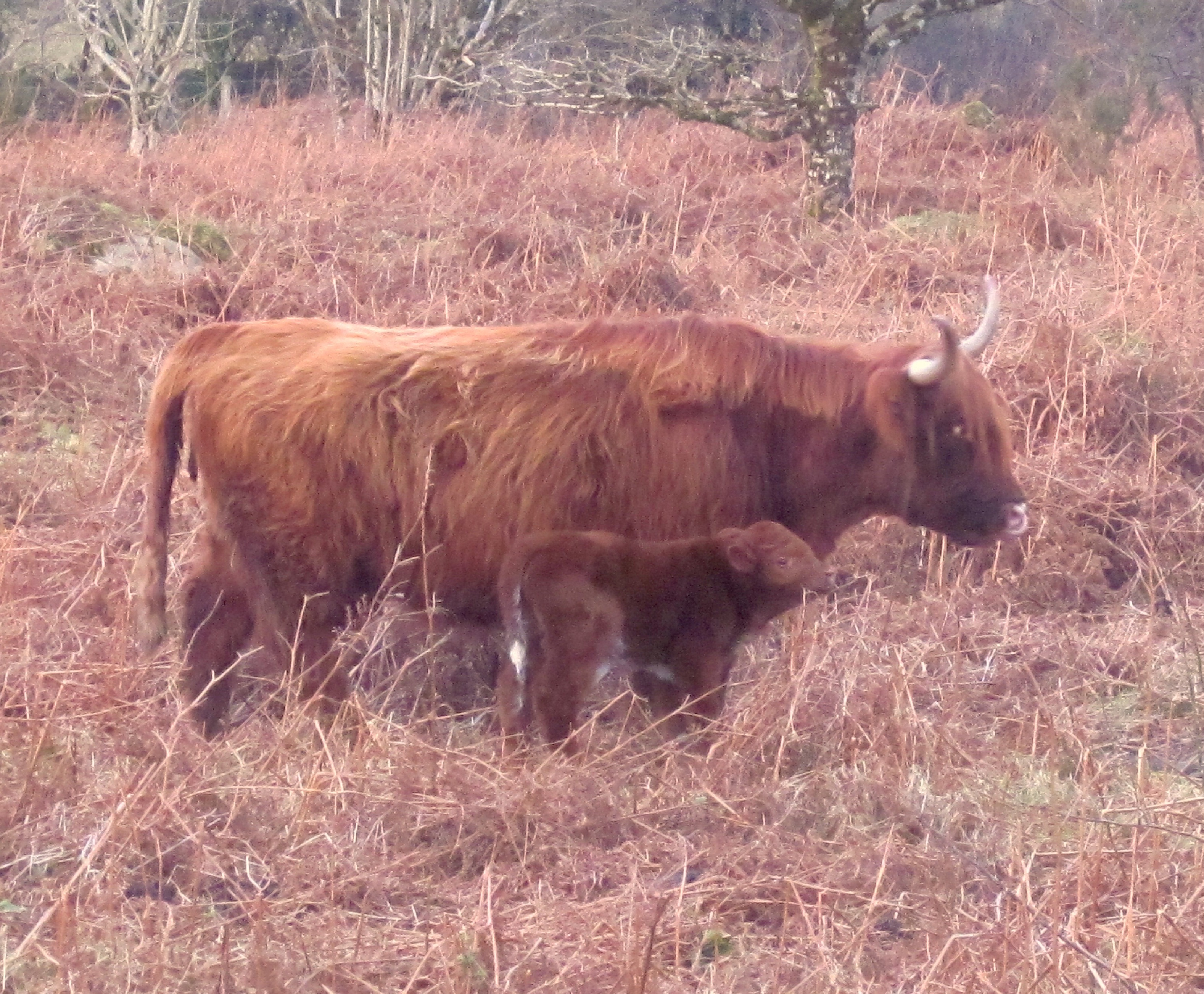 Late yesterday afternoon, I spotted this pair from my kitchen window. It looked as if the calf had been born just an hour or so earlier – the mother was still cleaning it (she’s still licking her lips in this shot) and it had taken its first feed (from the other side, unfortunately!). It could already walk and the pair refused to stand still for the camera, so it’s a bit blurred from a distance of 50 metres. Cute, though.
Sunday, 15 January 2012 1 Comment
Shamelessly borrowing the title of one of my favourite Beatles’ songs, here’s a photo I took early this morning on my way back from fetching the Sunday paper.

This view never fails to cheer me – it’s my local equivalent of Cézanne’s Mont Saint-Victoire, or so I like to think. It’s never fully in view and in the spring it is garlanded by a foreground of light green foliage. In winter, the trees provide a thicket of wild branches and twigs. On this rare sunny day in January (it’s been a wet and stormy start to 2012), the distant greens, oranges and greys basked in an extraordinary glow. There was even a buzzard circling, although at the moment I took the shot it flew behind one of the left-side twigs.
Saturday, 10 December 2011 Leave a comment
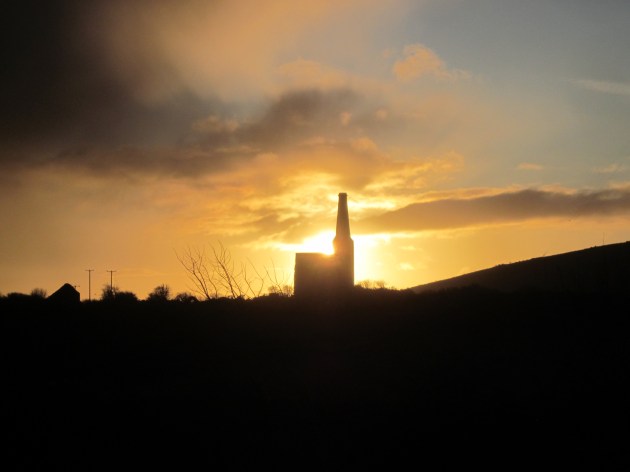
Another shot taken on my early-morning walks for the paper.
Saturday, 12 November 2011 Leave a comment
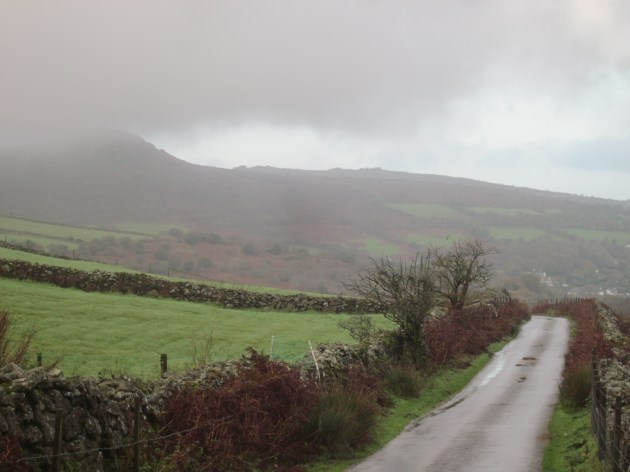
On the way back from collecting the paper, looking north.
Thursday, 10 November 2011 Leave a comment
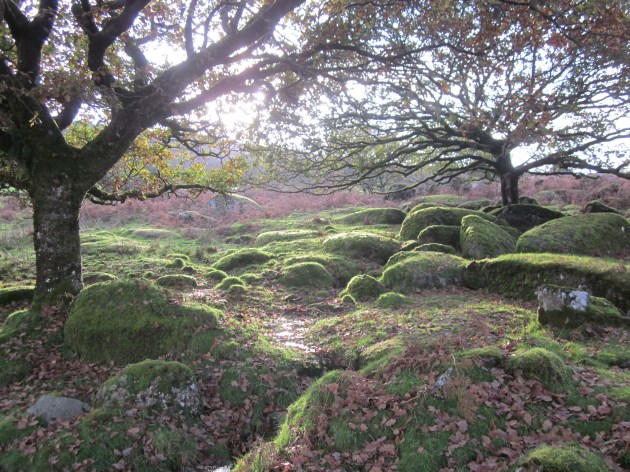
On a familiar stroll up to Bearah Tor, I passed the fairy grove of oak trees, the early stages of what will be a pointy monument at Hayling Island in Hampshire (to be dedicated to the heroes of COPP – Combined Operations Pilotage Parties – during World War II) and on up to the small, long-disused upper quarry that is now filled with water.


Sunday, 30 October 2011 Leave a comment
Bracken seems to have very little to commend itself. It’s invasive and takes over where there is no animal grazing. I used to think that it was a useless plant. It’s certainly dangerous to many animals, as well as potentially harbouring deer and sheep ticks that can cause Lyme disease. But it’s a food plant for the caterpillars of quite a few species of moth and butterfly, so it’s not all bad.
It appears in May, after the bluebells. First there’s a little hoop in the grass, then – pwhang – it uncoils, straightens its back, and shoots up faster than you can say ho-ho-hum. Before you know where you are, its jungles can tower above you.
However, autumn and winter present a different story. I’ve been surprised how short-lived bracken is. Here on the moor it starts turning in August and the decay accelerates through October. Suddenly vistas open up, grassy paths become clearer. Initially, this decay seems featureless, but I’ve learned to look out for something extraordinary. Between now and next April the bracken will provide the most beautiful array of colours and shapes.

At the moment, the stalks have turned pale lemon-yellow. Later they’ll become dark, burnt orange to purple-black, often broken over mid-stem by the wind, creating a dramatic canvas of criss-crossing diagonals and verticals. Some of the fronds have already gone a mid-brown, matt-dull, while others cling on to vestiges of their summer colour, freckled with age spots and yellows as the sap drains out. But in the sunlight they glow as they die. Best of all is the effect of a heavy shower of rain, which restores lifeless colours to a point of magnificent saturation. At such moments one can almost forget, but not forgive, the pest that will spring forth and claim more territory next year.
Monday, 24 October 2011 Leave a comment
It seems to me, with the wind howling and the rain driving all before it on this bleak October day, that this is a good moment to stay indoors and shift my blogging to a dedicated provider rather than bury it in my iWeb site. Better that than go for a walk along the Cornish cliffs, where you never know what might happen.
This footage was shot a month ago, on 23 September 2011, at 17.00, looking north east. It’s on a section of the north coast in West Cornwall, where the cliffs are formed of slate. It’s called Dead Man’s Cove. No-one died. No animals were hurt. But some of the human ‘noises off’ might suggest otherwise.
Cornwall Community News carried the full story, with pictures, on 15.10.2011.
Saturday, 22 October 2011 Leave a comment
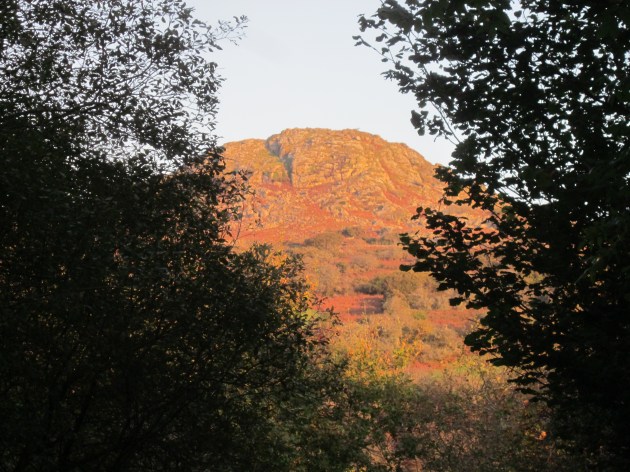
This is one of my favourite views of Sharp Tor, from the road between Higher Stanbear and Henwood.
Sunday, 16 October 2011 Leave a comment
On a visit to the always fascinating interior of Lanhydrock House n, I made a beeline for a little side-room where hangs a huge map of the West Country made by the 18th-century cartographer Robert Tindal, his ‘Continuation of Mr Rapin’s History’. Here’s a close-up of eastern Cornwall. It’s centred on my part of the county and displays a certain vagueness in its placement of features. A few spiky rocks mark ‘The Hurlers’ near what is now Minions, although for reasons of space the name is placed in a giant curve to the north. But it’s interesting to see it highlighted as a significant feature. And I’m taken with the spelling of my nearest town, Leschard. There’s also an interesting and – to me – unfathomable road linking Tavistock with Bodmin, running north of Killington (Callington) and between The Hurlers and Liskeard. I wonder how accurate that is and where it passed through.


 Cornish Adrian