• The Cello in Art (3) – Jonah Bokaer

Jonah Bokaer: On Vanishing (2011)

This has to be one of the most stunning photographs of a dancer in recent years.  I’m just fascinated by its lines, the merging of the body and reflection into an indivisible sculpture, at once static yet full of energy.  The eye can’t help but travel through, across, along.  Absolutely wonderful.

“Where’s the cello?”, you might ask.  Well, this photo is a publicity still for a performance last month by the American dance and media artist, Jonah Bokaer.  On Vanishing was premiered at the Guggenheim Museum in New York on 14 July 2011, with Bokaer (above) and four other dancers, in response to an exhibition of work by Lee Ufan, ‘Marking Infinity’.  This 40-minute ‘choreographic dialogue with sculpture’ (Lee Ufan’s steel wall and two rocks) was accompanied by a performance of a late work by John Cage.  His One8 for solo cello (1991) was played by Loren Kiyoshi Dempster.

“How does the body erase itself, to prefer matter against presence?” (Bokaer)

Photo © Michael Hart, 2011

To get a taste of Bokaer’s extraordinary choreographic imagination and dynamism as a dancer, here’s a clip he posted of his short solo piece False Start (2007; premiered 2008, New York).  A Petrushka for our time, 100 years on.

The Cello in Art (2) – Jean-Baptiste-Camille Corot

Corot: Le Moine au violoncelle (1874)

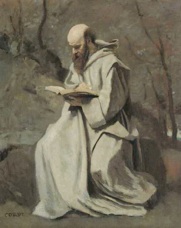
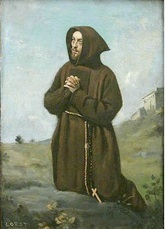
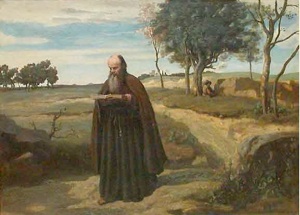
There is something immeasurably sad about Corot’s Monk with a Violoncello, one of his last works.  But then, none of his several portraits of monks shows one in a state of religious ecstasy.  They’re totally absorbed in the seriousness of their own contemplation.  Somehow all of these paintings seem anachronistic for the mid-to-late 19th century.

        Le Moine au violoncelle is also an odd painting because, unlike the others below, the monk is given no context.  Why is he playing alone, in an empty room?  Is he practising?  What is he practising?  Would he normally be part of his monastery’s chapelle, accompanying hymns or psalms or other parts of the liturgy?  Was his repertoire purely sacred?  If he really is a cellist, then he must have some ability, as he’s playing in a high position on the fingerboard.  By the looks of him, he’s a Franciscan monk, so maybe he’s playing to the birds from his cell …

• The Cello in Art (1) – Carl Holsoe

I am deep in writing a study of Lutosławski’s Cello Concerto (1969-70), so I sometimes stray into the other arts in search of cello-related items.  Two days ago, I came across this haunting painting by an artist new to me (he’s not even listed in Wikipedia!).  Carl Vilhelm Holsoe (1863-1935) was a Danish painter and contemporary of the better-known Vilhelm Hammershøi (1864-1916).  I really enjoyed an exhibition of Hammershøi’s work at the Royal Academy in London three years ago.  They evidently shared a fascination with the spare domestic interior, often including an unidentified human figure – usually female – facing away from the viewer.  This gives their pictures an introspective air, reminiscent of 17th-century Dutch masters.  Holsoe’s colour palette seems to be richer than Hammershøi’s, whose work is more coolly enigmatic.

I haven’t been able to find out much about Holsoe, but there are at least six paintings which include a cello, though it’s never being played.  In one it’s leaning against the same chair as above, as well as against what seems to be a clavichord (another homage to Vermeer, this time to his virginals).

The most touching is the only one with a human figure, a young woman seemingly taking a step towards the instrument, resting her hand on the back of a chair while gazing out of the window.  In another interior not included here,she is reading music seated in front of the same keyboard.
For me, the most resonant image is the one at the top of this entry, although it is also the starkest despite the sunlight illuminating the rug and cello from the side.  There’s something about the cello’s pose – rakish, nonchalant – that suggests that it’s only just been put down after music-making.  Is a parallel with what looks like a reclining figure on the face of the moulded stove too fanciful?  Stoves, including this one, recur elsewhere in Holsoe’s work.  His own home and family are most likely to have furnished his subject-matter, but did he play the cello himself?