Saturday, 17 September 2011
After my dormouse encounter a few days ago (Mists and Mellow Fruitfulness), I never thought that within four days I’d repeat the experience but on a much larger scale. It just goes to show that being in the same location as a wild animal is a matter of pure luck.
There I was, early evening, mowing the grassy paths in the wood, a rough and ready operation that I undertake once a fortnight. There are four up-down E-W paths, four cross-paths S-N, all meandering round the trees and lie of the land (dodging rabbit burrows and huge granite boulders). The one-acre wood itself is mostly deciduous, with a range of species including a good few oak, poplar, hornbeam, ash, elder, apple trees, buddleia, privet, hawthorn, crab apples. It looks really wonderful in the spring, smothered in bluebells. At this time of year, the fruit of the rowans and apple trees are very colourful.
I’d done the perimeters and the up-down paths and at just before 19.00 was mowing the little ‘ride’ among the cherry and crab apple trees (I hasten to add that I ride on nothing – this is a little battery-operated push mower). Suddenly, there was a whoosh overhead and a fully grown buzzard landed on a 10’-high stump of an old pine tree, not 15m away. They’re big birds, standing 20”+ tall and with a wing span of around 4’. They’re impressive, but in my limited experience they fly away from humans rather than wanting to be near them. This one seemed quite determined to stay.
I paused to watch and admire, the buzzard, unfazed, started to preen. So I decided to carrying on with my job, mowing up and down for another 10’. Then I had to do the cross-paths, which took me a bit nearer. Three passes of the first one and the buzzard was still on its perch. It was hidden from view from the second, closer cross-path, but it could probably see me. I finished the first pass, stopping at the junction with a down path. I looked up at the stump to the right – no buzzard. I thought, ‘That was special, but I’m not surprised that it’s flown as I’m now appreciably nearer’.
I turned to face the big, waist-high oval boulder in front of me and, to my complete astonishment, there was the buzzard, framed by decaying bracken less than 3m from me, standing on the mossy covering of the rock. I’d not seen it when I first stopped. It seemed completely unconcerned, eyed me up and down, and then slowly winged its way onto the horizontal branch of a dead willow, just 10m further on, the other side of the rock and above the crab apples. I stood in awe for a while, then resumed mowing the second cross path, followed by the third and fourth. As I came down again towards the boulder, I glanced to my right – the buzzard was still on its branch. So I parked the mower down by the gate, walked back up the ‘ride’ and stood watching the buzzard in full view, from a distance of no more than 8m. It carried on preening its wing, lower and upper breast feathers, sometimes looked directly at me, sometimes peered into the undergrowth, seeming to be totally at ease in the approaching dusk. It was only a further 10’ later that it sloped off over the cherry trees and out onto the moor.
As with my 60” with the minute dormouse, I felt incredibly privileged to have enjoyed the company of this magnificent bird of prey for over half an hour.

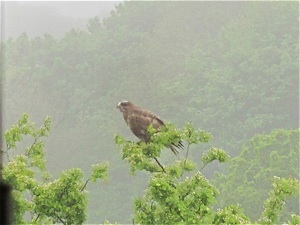
Unfortunately, I had no camera with me, so all I can offer by way of compensation are a couple of photos taken from indoors (apologies for the window latch) in early May this year. On that day, a buzzard managed to maintain its precarious perch on a hazel tree for several minutes in windy, wet weather. Magical in its own way.

 Aren’t words wonderful? There I was, looking for a brief post, and my eyes lit upon this image. It’s called Le Sabordage, another in the series of inspired photographs by Robert Doisneau in collaboration with the whacky cellist Maurice Baquet.



 Autumn seems early this year, but blackberrying was already done by this time in 2010 and it hasn’t started properly yet. Other things are already changing colour – the horse chestnut is bronzing rapidly, the crab apples blushing. This liquidambar, which I planted just under two years ago, has established itself well and is colouring nicely, and there should be a few more weeks of changing tints and densities.

 Cornish Adrian