This is probably a less familiar image than the previous one by Augustus John, and there’s less evidence of a cello! In Portrait of a Man with Cello (1923), the Polish painter Jacek Malczewski (1854-1929) depicts the young man strumming the instrument like an upright guitar or a lowered violin. His languorous manner, slicked-back hair and exaggeratedly broad shirt collar, combined with the landscape, suggest nothing less than a weekend in the country along with a spot of music-making, don’t-ya-know. To my untrained eye, the man bears a striking resemblance to a previous portrait that Malczewski had made of his son Rafał (below). (Rafał also made a career as a painter, but he is best remembered as one of Poland’s most distinguished skiers and mountain-climbers. In 1917, he narrowly escaped death in the Polish Tatras. This portrait dates from that year.)
Earlier in his career, Jacek Malczewski had taken up Symbolism with a vengeance, and it is in this period that his most famous paintings were created. He was best known for his forthright portraits, but rare are those without other allegorical ‘presences’ counterpointing, peering over the shoulder of or threatening the subject. The most common ‘onlookers’ are chimeras (in Malczewski’s case, winged females with huge-thighed limbs and a lion’s claws), fauns and muses.
There is a number of portraits with musical themes and several of these reveal their folk origins by the inclusion of the narrow fiddle known as a gęśl. Below are three such paintings: Self-Portrait with Fiddle (c.1908), Music (1908) and Shepherd Boy and Chimera (1905).
It was inevitable that Augustus John’s sumptuous portrait (1920-23) of the Portuguese cellist Guilhermina Suggia would crop up early on in this thread. It’s become iconic for several reasons: THAT dress (apparently, his third colour choice), which reminds me of the voluminous red gown that Jacqueline du Pré wore on the one occasion that I saw her play (Haydn’s Concerto in C – one of the few pieces that Suggia also recorded – at London’s Royal Festival Hall); THAT profile, facing away from the cello (the very opposite of pretty much every photograph of du Pré); and THAT posture.
Suggia (1885-1950) was one of the first internationally known female cellists. It was only at the end of the nineteenth century, when the endpin (‘spike’ to you and me) gained popularity, that women began to take up the cello seriously. Up until then, it had not been thought seemly for a women to grasp the cello between her knees and lean low to play it. The spike changed all that: the posture could be more upright and – this I didn’t know – enabled a woman to play the cello placed elsewhere than between her legs. Some played it side-saddle and some with the right leg bent low behind the instrument. An outdoor photograph of the slightly younger English cellist Beatrice Harrison (1892-1965) – yes, she of the BBC nightingale broadcasts and recordings – shows her in this latter position, with spike in place. It looks uncomfortable, restrictive and not a little ungainly. I wonder what Scottie was thinking … keeping out of range if his mistress decided to go wanton on the A string?
Suggia, on the other hand, had no qualms about posing in this highly expressive manner, even at a time (1920s) when female cellists were still a rarity and most professional orchestras were male-only domains. After being associated with Pablo Casals as his student and then partner for several years, she moved to England in 1914, quickly becoming known as ‘La Suggia’. Country Life (26 November 1927) published for its society readership a breathless, equine and barely veiled eroticised account of her presence and playing style which is worth bearing in mind when thinking of some more recent cellists:
It was a delight to see her, before each bout, sit up alert, balance and adjust her bow as a fencer balances his foil, then settle herself with huge tortoise between her knees, like jockey sitting down to the ride: erect at first and watchful, till gradually, caught by the stream she created, she swung with it, gently, sleepily, languidly, until the mood shifted, the stream grew a torrent and the group rocked and swayed almost to wreckage. Or again, she would be sitting forward, taking her mount by the head, curbing it, fretting it, with imperious staccato movements, mastering it completely, then letting it free to caracol easily, or once more break into full course, gathering itself in, extending itself, in a wild gallop. She was creating sound till you could see it: the music seemed to flow like running water, up her arms, over her neck; one felt that seated behind her one could see it coursing down her shoulders and her spine, with the whirls and eddies of a mountain river.
Only the face remained apart: in it was something different: the face with its closed eyes belonged to us who were played upon rather than to who played: it was the artist in the artist’s other role, her own audience, listening to herself, experiencing first and more than all other the emotion which her art evoked. That rapt and passive countenance, that swift ordered disciplined activity of every fibre of her body, disciplined till all was instinctive as the motions of a flying bird showed once and for all her double nature, speaker and listener at once, actor and spectator, which must be the artist’s.*
* I’m grateful to Anita Mercier’s fascinating and revealing article on Suggia for the excerpt from Country Life; see <http://www.cello.org/Newsletter/Articles/suggia.htm>. Mercier has also written a full-length study, Guilhermina Suggia: Cellist (Ashgate, 2008).
Suggia had a strong personality, and Augustus John captured a snapshot of the passion and imperiousness of her character. The audio link to Bruch’s Kol Nidrei (below) is to one of the few recordings she left to posterity. It was recorded in the same year as the Country Life review, so makes for an interesting counterbalance to its linguistic extremities and to the fiery temperament implied by John’s portrait. I think it is stunningly beautiful, measured, direct and, yes, expressive but in a restrained way that befits Bruch’s music.
This has to be one of the most stunning photographs of a dancer in recent years. I’m just fascinated by its lines, the merging of the body and reflection into an indivisible sculpture, at once static yet full of energy. The eye can’t help but travel through, across, along. Absolutely wonderful.
“Where’s the cello?”, you might ask. Well, this photo is a publicity still for a performance last month by the American dance and media artist, Jonah Bokaer. On Vanishing was premiered at the Guggenheim Museum in New York on 14 July 2011, with Bokaer (above) and four other dancers, in response to an exhibition of work by Lee Ufan, ‘Marking Infinity’. This 40-minute ‘choreographic dialogue with sculpture’ (Lee Ufan’s steel wall and two rocks) was accompanied by a performance of a late work by John Cage. His One8 for solo cello (1991) was played by Loren Kiyoshi Dempster.
“How does the body erase itself, to prefer matter against presence?” (Bokaer)
To get a taste of Bokaer’s extraordinary choreographic imagination and dynamism as a dancer, here’s a clip he posted of his short solo piece False Start (2007; premiered 2008, New York). A Petrushka for our time, 100 years on.
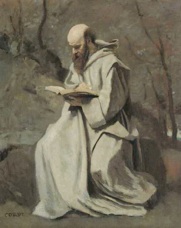
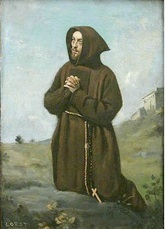
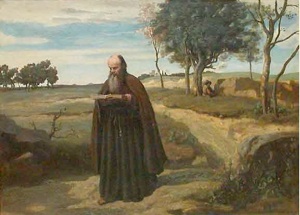
There is something immeasurably sad about Corot’s Monk with a Violoncello, one of his last works. But then, none of his several portraits of monks shows one in a state of religious ecstasy. They’re totally absorbed in the seriousness of their own contemplation. Somehow all of these paintings seem anachronistic for the mid-to-late 19th century.
Le Moine au violoncelle is also an odd painting because, unlike the others below, the monk is given no context. Why is he playing alone, in an empty room? Is he practising? What is he practising? Would he normally be part of his monastery’s chapelle, accompanying hymns or psalms or other parts of the liturgy? Was his repertoire purely sacred? If he really is a cellist, then he must have some ability, as he’s playing in a high position on the fingerboard. By the looks of him, he’s a Franciscan monk, so maybe he’s playing to the birds from his cell …
Yesterday, I got in from a convivial evening with friends at the Rising Sun near Altarnun just in time to catch Radio 3’s late-night Hear And Now, a broadcast of a brilliant concert from this year’s Spitalfields Festival. It was given by Chroma and featured works by Param Vir (Hayagriva) and Jonathan Harvey (Sringara Chaconne). But for me the highlights were two works by Rolf Hind: Horse Sacrifice (2001) and the premiere of Sit, Stand, Walk (2011).
photo: Alys Tomlinson
I should declare an interest here: Rolf spent nine days in Cornwall in July 2010, meditating intensely indoors and outdoors (though not on a deckchair, as I recall). More importantly, he composed one of the movements of Sit, Stand, Walk in my music room. His stay has spurred me on to get quotes for converting the garage into a proper studio where artists of any discipline can come and be creative away from their normal hustle and bustle.
I first met Rolf when he came to give a recital at Queen’s University, Belfast, in the mid-1980s. I’ve never forgotten his stunning performances of Beethoven, Copland and Carter sonatas that evening. Few pianists can match his total dedication to new music and it’s no wonder that composers specifically ask to work with him, knowing that he’ll get to the heart of their music, both interpretatively and technically. So it’s great that the tables are now turning and performers are asking to work on his own growing output as a composer.
He has a distinctive voice that comes in large part, I suspect, from the tough demands that he makes on himself in his Buddhist meditation. He also has an acute ear for the delicate balance of musical continuities and discontinuities, for ritual and for unusual instrumental sonorities and combinations. The solo-ensemble drama of Horse Sacrifice played out like a miniature concerto, deft, expressive and perfectly formed, with a particularly atmospheric final movement.
Ten years on, Sit, Stand, Walk revisits the concerto principle, this time with the clarinet (a virtuosic performance from Stewart King) as protagonist. This was even more like a journey of the soul, revealing the interior through tender antiphony (or antiphonal tenderness?) between the soloist and the slowly-gathering reflectors of the other instruments. The ritualistic punctuation of the percussion was offset by unexpected colours, especially that of the accordion, which whetted the appetite for Rolf’s forthcoming accordion concerto (for James Crabb and the BBCSO). This was a haunting exploration of the experience of meditation, completed by a brief fourth movement ‘Open’, which the composer rightly called ‘an exponential explosion of joy’. A great piece and a fascinating concert of meditation-inspired pieces, though perhaps before midnight on a Saturday was not the most ideal placing!
I am deep in writing a study of Lutosławski’s Cello Concerto (1969-70), so I sometimes stray into the other arts in search of cello-related items. Two days ago, I came across this haunting painting by an artist new to me (he’s not even listed in Wikipedia!). Carl Vilhelm Holsoe (1863-1935) was a Danish painter and contemporary of the better-known Vilhelm Hammershøi (1864-1916). I really enjoyed an exhibition of Hammershøi’s work at the Royal Academy in London three years ago. They evidently shared a fascination with the spare domestic interior, often including an unidentified human figure – usually female – facing away from the viewer. This gives their pictures an introspective air, reminiscent of 17th-century Dutch masters. Holsoe’s colour palette seems to be richer than Hammershøi’s, whose work is more coolly enigmatic.
I haven’t been able to find out much about Holsoe, but there are at least six paintings which include a cello, though it’s never being played. In one it’s leaning against the same chair as above, as well as against what seems to be a clavichord (another homage to Vermeer, this time to his virginals).
The most touching is the only one with a human figure, a young woman seemingly taking a step towards the instrument, resting her hand on the back of a chair while gazing out of the window. In another interior not included here,she is reading music seated in front of the same keyboard.
For me, the most resonant image is the one at the top of this entry, although it is also the starkest despite the sunlight illuminating the rug and cello from the side. There’s something about the cello’s pose – rakish, nonchalant – that suggests that it’s only just been put down after music-making. Is a parallel with what looks like a reclining figure on the face of the moulded stove too fanciful? Stoves, including this one, recur elsewhere in Holsoe’s work. His own home and family are most likely to have furnished his subject-matter, but did he play the cello himself?
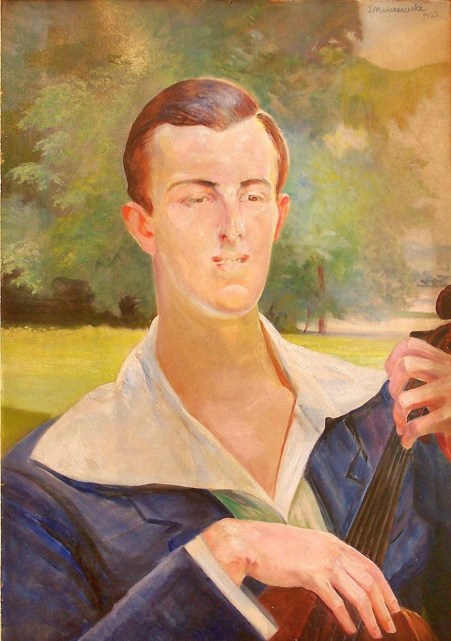 This is probably a less familiar image than the previous one by Augustus John, and there’s less evidence of a cello! In Portrait of a Man with Cello (1923), the Polish painter Jacek Malczewski (1854-1929) depicts the young man strumming the instrument like an upright guitar or a lowered violin. His languorous manner, slicked-back hair and exaggeratedly broad shirt collar, combined with the landscape, suggest nothing less than a weekend in the country along with a spot of music-making, don’t-ya-know. To my untrained eye, the man bears a striking resemblance to a previous portrait that Malczewski had made of his son Rafał (below). (Rafał also made a career as a painter, but he is best remembered as one of Poland’s most distinguished skiers and mountain-climbers. In 1917, he narrowly escaped death in the Polish Tatras. This portrait dates from that year.)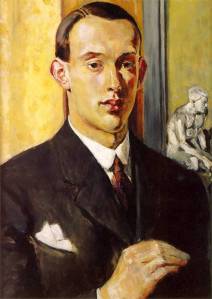




 Cornish Adrian