• Never Weather-Beaten Saile

Having learned earlier today of the death of Tony Fell, I chanced to hear on BBC Radio 3 Hubert Parry’s Never Weather-Beaten Sail.  Lovely though it is, my mind’s ear went straight back to the original words and music of Thomas Campion’s evocative ayre, which I remember singing as a madrigal.

I first met Tony in the mid-80s while briefing Boosey & Hawkes about its potential new signing, Henryk Mikołaj Górecki.  I realised straightaway that I was talking with a doer, someone who liked to get things going, always with charm, enthusiasm and a witty sense of humour.  He will be greatly missed.

Tony died on Górecki’s birthday – 6 December.  Here, as a little farewell, is a link to a performance of Campion’s Never Weather-Beaten Saile, this time in its first version, for voice and lute.


Neuer weather-beaten Saile more willing bent to shore,
Neuer tyred Pilgrims limbs affected slumber more,
Than my wearied spright now longs to flye out of my troubled brest :
O come quickly, sweetest Lord, and take my soule to rest.

Euer-blooming are the ioys of Heau’ns high Paradice,
Cold age deafes not there our eares, nor vapour dims our eyes :
Glory there the Sun outshines, whose beames the blessed onely see ;
O come quickly, glorious Lord, and raise my spright to Thee.

• The Cello in Art (14) – Edwin Holgate

While writing my preceding post on Canadian artists, I read through my copy of The McMichael Canadian Art Collection (1989) and chanced upon this painting.  The Cellist (1923) is by Edwin Holgate (1892-1977).  Holgate became associated with the landscape-oriented Group of Seven after its heyday and is primarily known for his portraits.  Not perhaps one of the more extrovert examples of the cello in art in these occasional postings, but I like its strong lines and colour palette.  Holgate also brings a physical intensity and an almost 3-D realism to his study of a cellist engrossed in her playing.

• The Cello in Art (13) – Rippingille

On my recent visit to Bristol, I popped into the Bristol Museum and Art Gallery.  It’s a spacious building, though not overly large, yet it manages to encompass the natural sciences and world cultures as well as a selection of art forms across the centuries.  Today it’s best known perhaps for letting Banksy loose on its exhibition spaces in 2009, and right there in the entrance hall is a stone carving of an angel with an upturned can of red paint on its head.  Upstairs, there are some fine examples of British painting and sculpture across the centuries, and, small though it is, the selection of works by Ben Nicholson, Barbara Hepworth, Peter Lanyon, Howard Hodgkin, Richard Long and others works well as a taster.

I knew nothing about the Bristol School of Artists, which has a gallery more or less to itself.  Having seen the exhibition of work by The Glasgow Boys at the Royal Academy last year and the excellent play The Pitmen Painters a few years ago and last year’s superlative ITV documentary about the Ashington Group in Northumberland, I was curious to see what the much earlier group in Bristol was about.  It appears to have been a loose association of artists, amateurs as well as professionals, who liked nothing better than to go out of an evening on sketching parties to local beauty spots like the Avon Gorge.  Its heyday was in the 1810s and 1820s, and its chief luminaries were genre and landscape painters such as Edward Bird (1772-1819), Francis Danby (1793-1861) and Edward Villiers Rippingille (1789-1859).

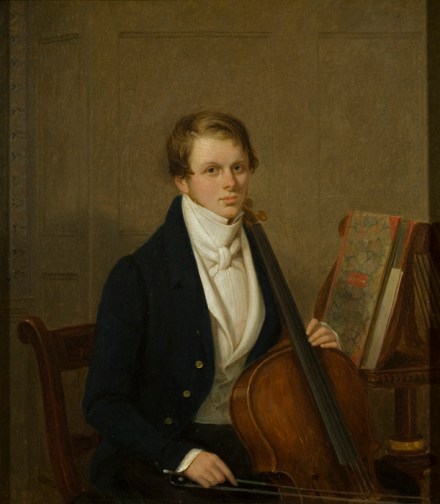
I was particularly drawn to this small oil painting by Rippingille, mainly because it offered a new image to add to my occasional posts on ‘The Cello in Art’ (see below).  This portrait (c.1829) is of a well-to-do young man, dressed ‘to the nines’.  He was John Whitmore Isaac from Worcester (1808-84), so he was then about 21.  Isaac is holding the instrument naturally, which suggests that he may well have been a cellist himself.  His bow-hold is not on the ‘frog’ but further along the stick, which recalls the practices of the 18th century, as demonstrated in a portrait of the composer and cellist Luigi Boccherini (1743-1805).

Yet Isaac’s bow is a modern one, so no doubt he changed his bow-hold at some point to that which had become standard during his own lifetime.  A bound volume of music by Haydn is on the music stand, with what look like loose sheets protruding.  If this was a real volume in Isaac’s possession, what music did it contain?  String quartets?  Trios?  Keyboard sonatas?

There the story might have ended – a delightful and unassuming portrait of a youthful West Country gentleman and cellist – had I not perused the search engines a little further.

John Whitmore Isaac’s name subsequently came up as a one-time owner of one of the most famous Stradivari cellos, the ‘Mara’ cello of 1711.  Isaac bought it, however, at a much later date than that of his portrait above – 1860 – and the ‘Mara’ stayed in his  family for over 25 years.  Did Isaac play Haydn quartets on it too, I wonder?  The ‘Mara’ then seems to have languished away from the concert platform until it came into the possession of Anthony Pini in 1950 and then into the hands of Amedeo Baldovino in 1954.  Baldovino almost lost the instrument when the ship in which he was travelling was sunk in the River Plate in 1963.  Unsurprisingly, the cello suffered severe water damage.  It was repaired for £1000 by the firm of W. E. Hill, which had owned the instrument from time to time since buying it off the Isaac family.  The ‘Mara’ is now owned by Heinrich Schiff, who bought it in 1996.

As a further footnote, connected to my study of Lutosławski’s Cello Concerto, which Schiff first played in 1972 and recorded in 1986, it is clear that there is no link here either with the ‘Mara’.  Instead, it is likely that Schiff recorded the Lutosławski on an earlier Stradivari (‘St Senoch, Murray’, 1698), which he owned between 1981 and 1995.

• Fats Waller – The Spider and The Fly

As I’m going into a virtual hermitage in order to meet an important deadline, this will be my last post for a month or so.

Given the stories about the large number of randy male spiders coming indoors this autumn looking for females (a fact about rural arachnids which I can verify), I thought that Fats Waller’s popular song from 1938 could hold the groove while I free myself temporarily from the web.

In Waller and Andy Razaf’s version, however, it is the male who has the parlour …

• The Cello in Art (12) – Courbet

In his many self-portraits, Gustave Courbet (1819-77) gives himself the air of a wild man.  They vibrate with a visceral energy that reminds me of Michelangelo Merisi da Caravaggio (1571-1610).  But I would rather trust Caravaggio than Courbet with the faithful representation of musicians and how musical instruments are held or played.

These two youthful self-portraits – above, The Cellist (1848), now in the National Museum in Stockholm, and, below, the earlier The Violoncellist (1847), now in the Portland Art Museum – are fascinating for a number of reasons.

Courbet wasn’t musical and didn’t play any instrument.  He’s also playing left-handed, which is very rare.  There’s no evidence that he was left-handed as a painter.  Was he looking in a mirror?

The way in which Courbet is ‘playing’ the cello is a joke.  For starters, he’s wearing it far too off-the-shoulder, like a louche model giving the come-on.  In fact, while his left arm gives the impression of playing, his right hand is doing nothing, just resting on the neck where it meets the body of the instrument.  His extremely long fingers, vividly painted, are in no position to stop a string for the bow to resonate.  So it’s merely a painterly pose, with no genuine attempt to portray the act of cello playing.  Commentators have remarked that the bow is a metaphor for his paint brush.  If so, then we might equally see the position of his right hand as if holding his painter’s palette.

That’s all fine and dandy, but to suggest that these paintings are a metaphor for the act of painting ignores the fact that the musical side of the equation is inadequate, not to say unreal.  Does that not have an impact on the other side of the equation, implying that his art is sloppily thought through?  That clearly is absurd.  But anyone with a knowledge of music and its performance is bound to be puzzled and dismayed by Courbet’s cavalier attitude to musical practicality or accuracy.  He might just as well have painted himself with a brush and palette, and have done with it, because the musical parallels are so deficient.  The modern equivalent is the miming on film and TV which purports to show a singer or player in the act of genuine performance when this is patently not the case.  Non-musicians often aren’t in the least bothered by such fakery, not understanding or caring how musical performance works.  Courbet shared this attitude.  Realism had its limits.

There is, however, a uniquely strange aspect to one of these self-portraits.  The earlier one, immediately above, has been vandalised.  This remains one of the most extraordinary acts in the history of pre-twentieth-century art.  For reasons which remain a mystery, Courbet cut out the blank top right quarter of the picture and substituted a new piece of canvas with an image of multiple layers of printed music on a stand.  The music is irrelevant to the main image, however, except as a prop on the side, because Courbet’s eyes are totally fixed on the viewer (or on himself, the poser/poseur, in the mirror).

If it wasn’t apparent at first glance, it quickly transpires that the musical deficiencies of this pair of paintings, and the cut-and-paste of the Portland version, are irrelevant.  Courbet has set out to disturb and disquiet, ensuring that the only reality is his own ego: that face and those hands.  Nothing else matters, as if provocatively suggesting that the viewer can get lost (or any one of numerous other rude rejoinders) if he or she doesn’t like it.  Yet we come back for more.  That’s the power of his personality.

• The Cello in Art (11) – Doisneau and Baquet/3

Aren’t words wonderful?  There I was, looking for a brief post, and my eyes lit upon this image.  It’s called Le Sabordage, another in the series of inspired photographs by Robert Doisneau in collaboration with the whacky cellist Maurice Baquet.

• Not knowing what sabordage meant, I had to scurry to my Harrap’s Shorter French and English Dictionary (1).
• On the way, I knocked over the family’s Old English coal bucket (2).
• And I discovered that it means the deliberate sinking of one’s own ship (3).

• Radio 3 – Hear and Now Fifty

Well, you can see from the preceding post Toothless, Lame and Lazy that I get hot under the collar about all this celebrity endorsement.  It’s as if programme makers (or more likely their executive seniors) don’t believe that music can stand up for itself.  You can imagine my horror when I heard a few days ago about the celebrity component planned for a Radio 3 bastion of musical self-sufficiency, Hear and Now.

This strand, under different titles, has long stood up for contemporary musical creativity.  It’s always been forward-looking, innovative, challenging.  I reported on a characteristically intriguing edition last month (Sit, Stand, Walk).  But even Hear and Now has not been able to resist the pressure to make an ‘essential collection’, the Hear and Now Fifty.  It’s going to be 50 works from 50 years (1950-99) chosen by 50 ‘figures from the worlds of new music and the arts’.  I wonder what the strand’s successor collection will be called next September, because once you’ve started down this path there’s no going back.

As usual, the promotional material has its own brand of tosh: ‘This rich legacy can now be viewed without the prejudices and barriers that dogged its perception at the time’.  Excuse me?  ‘Viewed’?  ‘Dogged’?  ‘Its (the legacy’s?) perception’?

Are we to understand that we are equally distant in time, prejudices and barriers from a work composed in 1999 as we are from one written in 1950?  Have the 50 pieces therefore been chosen for their revisionist potential?  And what about being dogged by today’s prejudices and barriers?

At least it looks as if the ‘50’ will not take over the whole programme each week, which leaves Hear and Now free to continue to pursue its traditional targets.  My initial horror is somewhat lessened by the range, calibre and potential of the creative input from the ’50 figures’.  The first batch looks like this:

17 Sept.    Steve Reich: Different Trains (1988), with electronic music producer Matthew Herbert
24 Sept.    György Ligeti: Atmospherès (1961), with film maker Sophie Fiennes
1 Oct.        Elliott Carter: String Quartet no.3 (1971), with novelist Mark Haddon
8 Oct.        Pierre Boulez: Le marteau sans maître (1955), with composer Sir Harrison Birtwistle

Thereafter we are promised:

Louis Andriessen: De Staat (1976), with composer Michael van der Aa
Iannis Xenakis: Nomos Alpha (1966), with Marcus du Sautoy (again)
Cornelius Cardew: The Great Learning (1970/72), with pianist John Tilbury
John Cage: 4’33” (1952), with artist Tacita Dean
Edgard Varèse: Poème electronique (1958), with composer Tyondai Braxton
Morton Feldman: Extensions 3 (1952), with composer Howard Skempton.

Further, incomplete details indicate that the jazz pianist Ethan Iverson will introduce something by Milton Babbitt, Kronos’s leader David Harrington will introduce George Crumb’s Black Angels (1970), and that Karlheinz Stockhausen’s Gruppen (1957) and Toru Takemitsu’s score for the film Kwaidan (1964) will also feature.

It will be interesting to see what the remaining pieces will be.  If Hear and Now is intent on creating a specific canon, how much editorial control has been applied to the repertoire to shape this canonicity?    And how many of the composers and pieces will be as unestablished or ‘non-core’ as in the programme’s habitual focus?  The answer to this last question is particularly key.  If the majority of the ’50’ are of the ‘classic’ status of most of the first ’10’ above, then they will sit awkwardly within the current experimental ethos of this strand, although I can see that they might well have been in the strand had it been running that long ago (there’s a musical-historiographical agenda here).  On the other hand, each ‘1’ may provide an interesting context for the ‘now’ pieces that happen to be in its particular edition of ‘Hear and Now Fifty’.  So there is potential in these juxtapositions; they won’t necessarily be safe.  I’m coming round to the idea.

Hang on a minute.  If each week’s Hear and Now is losing a good proportion of its airtime to these ‘50’, doesn’t that mean that its core mission has been irrevocably diminished?  That is hugely to be regretted.  Why didn’t Radio 3 instead extend its new titling fixation and create a third, contemporary, ‘Classics’ programme that would complement Hear and Now rather than steal from it?

It is, however, a sad sign of our times that most of these ‘50’ works are unlikely to be heard ever again on Radio 3.  So catch them while you can.  You can subscribe to the podcast introduction here –Radio 3’s Fifty Modern Classics (oh, so there is a ‘Modern Classics’ strand – I thought we’d lost it).

Essential Classics anyone?
Saturday Classics – anyone there?
• ‘Modern Classics’ 1-50, and counting?

(Later.)

The first edition of Hear and Now Fifty has just finished.  The 1/50 came at the end.  First were three pieces from the 41st Vale of Glamorgan Festival.  Under its originator and artistic director, John Metcalf, it has moulded a niche for itself by focusing exclusively over the past 20 years on music by living composers, with a strong emphasis on minimalism and on Australian and Eastern European music especially.  Although it is a small event – five concerts in five days – it punches above its weight, thanks largely to links and reciprocal arrangements built up over many years.

Three pieces were broadcast last night, all from the concert given on 8 September by the BBC National Orchestra of Wales, conducted by Jean-Michaël Lavoie: Metcalf’s Three Mobiles (with Gerard McChrystal, soprano sax), Mark Bowden’s Lyra (Cello Concerto, with Oliver Coates), and Qichang Chen’s Wu Xing (Qichang Chen was the Music Director of the opening ceremony of the Beijing Olympics – his ‘eclectic music will feature strongly in future Vale of Glamorgan Festivals’).

Three Mobiles seemed to have sprung from harmless, mainly American musical idioms current 80 years ago: eloquent, sweet-toned but anachronistic.  The third mobile began with some minimalist patter, but soon reverted to type, with a Coplandesque Hoe-Down threatening to burst out.  Mobility didn’t seem to come into it, certainly not from the perspective of Stockhausen’s Piano Piece XI (1956) or Serocki’s A piacere (1963).

Lyra is a more persuasive work.  With inspiration drawn first from the character ‘Lyra’ in Philip Pullman’s His Dark Materials, plus subsequent links with other meanings of the word (a constellation of stars, a small bass viol, a class of Soviet nuclear submarines), Bowden has fashioned a 20’, one-movement cello concerto by intermingling material from his initial three-movement plan, ‘Vega’, ‘Ayre’ (‘Air’?) and ‘Crushed Depth’.  The soloist spends much of the time in its high register against a busy and sustained orchestral backdrop.  The lyrical element is therefore very much to the fore, with little concertante interplay in the sense of actively working with or against the orchestra.  There are passages of frenetic movement, but no substantial interest in any real dialogue between cello and orchestra.  For most of the time, Bowden seems to hear the soloist as a textural and voluble primus inter pares.  Fifteen minutes in, the strings declaim a modern twist on the idea of a chorale theme and a more motivated and obviously co-ordinated section develops, driving both soloist and orchestra to a powerful climax before they separate again onto parallel tracks in the dying moments.

Wu Xing concerns the Chinese concept of the elements – they have five, not four: water, wood, fire, earth and metal.  Qichang Chen, who studied with Messiaen and has lived in Paris for almost 20 years, was apparently interested in the ways in which these elements could transform into each other.  The score is deliciously fluid, sometimes bearing the hallmark of his teacher, sometimes proving timbrally elusive and more ethnically Chinese.  Its five movements seem to live on the edge, taking unexpected detours, but always convincing in their journey.  He really understands the sonority of the orchestra and the value of material contrasts as well as continuities and the flexibility and balance of tempi.  Alluring, and the clear highpoint in this first of two Hear and Now broadcasts from this year’s Vale of Glamorgan Festival (next week: Steve Reich’s City Life from the same BBC NOW concert).
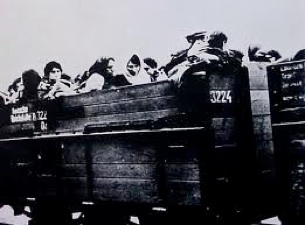
And so to the first of the ‘Modern Classics’: Reich’s Different Trains.  It occupied 35 of the programme’s 90 minutes, so over 1/3rd.  That’s 1/3rd lost to the core function of Hear and Now.  I don’t need to add my penny’s worth to the existing discourse on this piece, so what did Matthew Herbert and one of the series’s resident pundits Gillian Moore have to add that was new to the discourse?  Not much, in truth, though they did it in an engaging and intelligent manner.   They spoke over excerpts from the piece, separately and alternately, describing what they each heard as key features.  Reich himself made a brief and telling appearance at the very end.  It was a nicely edited nine and a half minutes.  Ideal podcast material.

But not a whisper about prejudices or barriers having dogged people’s perception in 1988 or since.

I return to my main concern.  Is this the best place to do this, at the expense of the coverage of music being written today?  I hope that Radio 3 will think that this format – a podcast introduction followed by a recording – is worth its own programme slot in a year’s time, called, if it must, Modern Classics.  That would allow Hear and Now to devote its full 90’ to contemporary music of today.

• Toothless, Lame and Lazy

This post was originally the first half of Radio 3 – Hear and Now 50 (the next post in the sequence).

BBC Radio 3 tried to persuade me to listen to a programme yesterday afternoon by informing me that it was to be presented by the country’s “best-loved choirmaster, Gareth Malone”.  Or so the M&S-style voice said.

Tell me, who writes this meaningless crap?  By what yardstick is Gareth Malone ‘our’ best-loved choirmaster?  Who decided that a choirmaster had to be loveable anyway?  Was there a poll that I missed?  Or is this just slack speak for “most-frequently-seen-on-BBC2-TV choirmaster”?  There is a difference, you know.  I can’t believe for one minute that this appropriation of simplistic advertising jargon attracts anyone, except Gareth Malone fans who are, by definition, already in love with him.  Watch it, Gareth.  Radio 3 promotion is lumping you together with CDs of best-loved melodies and anthologies of best-loved hymns.  Is that really where you want to be?

The programme?  Another stunningly inventive title from Radio 3 – Saturday Classics.

Saturday Classics

Malone’s theme over this and his next three programmes is ‘musical youth’.  I hope that this develops as a more meaningful connective tissue than it did yesterday.  First we had Mozart’s overture to The Marriage of Figaro, included because it was a good example.  Of what?  Because it was written when he was 30?  Then three excerpts from Vivaldi’s Gloria, simply because Malone’s mother used to play it to send him to sleep when he was young.  Ah, bless.  Then a story about unborn children being able to hear (hardly breaking news), about a singer rehearsing Aida while pregnant, etc..  Cue a chorus from – yes, you’ve guessed it.  The background to Elgar’s Dream Children was more interestingly told, but just because Chopin, like Mozart, was an infant prodigy hardly justifies playing his ‘Raindrop’ Prelude, composed when he was almost 30.  You could take any composer by this method, play a piece composed at that age, and claim a connection with ‘musical youth’.

And so it continued.  It was mild, comforting, thoroughly unchallenging musical fare, suitable for anyone without teeth.  In short, it was lame.  Malone ended with the phrase “I hope you enjoyed today’s romp through musical youth”.  Give me strength.

I just hope that future four-week presenters bring a bit more bite, insight and robustness to their themes (if they have to have them).  And that we get less standard fare.  We’re promised Simon Russell Beale, John Wilson and Alison Balsom, so let’s not give up quite yet.

The mania for ‘personal’ programming is getting thoroughly tiresome.  Whichever way you look at it, it’s a largely spurious approach to music.  If our ‘guide’ is strong, we remember his or her character and history rather than the music, which is incidental to such formats.  If weak, then the off button is suddenly very attractive.  It’ll be off for me on the next three Saturday afternoons.  What a relief it was to hear Geoffrey Smith at 17.00: a relaxed, cheery ‘HaLLO’, insightful commentary and a focus on the music.

Essential Classics

This juror is out with regard to another ‘Classics’ programme – Radio 3’s weekday morning sequence Essential Classics, whose title I lambasted two weeks ago.  It began inauspiciously last Monday with an instantly forgettable Czech composer and music (Oskar Nedbal’s Dance of the Brigands).  Its main ‘slot’ (after 11.00 each day) was worth hearing, however, not least because I trust Rob Cowan’s knowledge of recordings to provide interesting performances.  I’m far less convinced by the daily guest input.  This week the guest was the mathematician Marcus du Sautoy, next week it’s a gardening expert called Rachel de Thame.  Poor souls, they’ve had to fill out a questionnaire in preparation.  Have a look at these twenty questions and ask yourself a simple one in return: will the ‘piece’ itself be enhanced by knowing that someone else chose it for one of these reasons?

1.    What was the first piece of classical music you can remember hearing?
2.    What piece first stimulated your interest in classical music?
3.    What was the first classical record/CD you bought yourself?
4.    Do you have a favourite performer, and what piece would you choose to hear him/her/them play?
5.    If you could choose to be a virtuoso on any instrument, what would it be, and what piece would you like to play?
6.    Is there a piece you can play, or would like to play yourself?
7.    Do you have a favourite composer – and a favourite piece by him/her?
8.    What piece of music do you use to relax to?
9.    What piece of music makes you glad to be alive?
10.    What piece of music would you listen to on a journey (car/train/plane)?
11.    Is there a piece that you find particularly moving?
12.    Is there a piece that reminds you of a particular place?
13.    Is there a piece that makes you laugh?
14.    Can you work while listening to music, and what piece would you choose, and why?
15.    If you are entertaining friends, is there a particular piece you would put on?
16.    Is there a piece that you think should be more widely known – a hidden gem?
17.    Is there a piece of film or TV music that has particularly affected you?
18.    If you could step back in time to hear a great performer who’s no longer with us, who would it be, and what piece would you choose to hear?
19.    If we gave you an orchestra/choir/soloists, what piece would you choose to conduct?
20.    What piece of music do you want played at you funeral/to be remembered by?

In some cases, the answer might be yes (nos 16 and 18), something interesting about the music might emerge.  Some are downright idiotic (the ludicrous no. 9).  Most are intrusive and only interesting if you are interested in the person making the choice.  In other words, their answers are intrinsically a reflection on themselves (Desert Island Discs syndrome) rather than on the music.  Private Passions it ain’t, just a feeble imitation.  Or turn the process on its head. How many of the questions would fit the choice, say, of Bartók’s Fifth String Quartet or Webern’s Concerto for Nine Instruments, both of them works which have long been regarded as part of the canon of 20th-century classical music.  According to this questionnaire, I very much doubt that they are ‘essential’ any more.  I hope that I am confounded.

How about creating an alternative questionnaire?  Here are a few suggestions to start with:

1a.    What is the last piece of classical music you listened to?
2a.    What piece of classical music can’t you stand?
3a.    What was the first piece of music that you downloaded legally/illegally?
etc. …

Given that guests are likely to have achieved eminence in their field, just one question might have sufficed instead of the lazy twenty above: ‘What music has stimulated your own creativity?’.

• Fats Waller – First Recordings

I’ve long been curious about Fats Waller’s musical origins, such as stories about him learning the repertoire of stride piano by sticking his fingers on the keys as the piano roll depressed them.  Well, now that I’ve the opportunity to explore his legacy of some 600 recordings, I thought I’d begin by posting two of the earliest.

Waller made his first recordings as a solo pianist.  On 21 October, 1922, when he was 18, he recorded two tracks with connections to Alabama in their titles.  The first, played apparently more or less at sight, was George W. Thomas’s Muscle Shoals Blues.  As a B side, Waller improvised Birmingham Blues (below), which makes it also his first recording as a composer.  The characteristic right hand riffs are already there as is his legendary left-hand spread and the relaxed, bouncy manner in which he plays.  It’s very fresh and natural.

I’ve also posted a modern Yamaha DiscKlavier performance from a transcription made by Paul Marcorelles (below).  It makes for interesting viewing, because it demonstrates visually what Waller did in his early years to learn how to play stride piano.  It also gives a good idea of both Waller’s right-hand ornamentations as well as the distance covered by the left-hand stride.

Jump over some 20 not-so-interesting recordings of Waller as an accompanist (with the exception of two off-the-wall tracks with kazoos, wood-blocks and piano – You Don’t Know My Mind Blues and West Indies Blues – recorded by him in May 1924 as one of the Jamaica Jazzers) and you come to Waller’s first ‘orchestral’ recording, The Henderson Stomp.  He made this as a member of the Fletcher Henderson Orchestra on 3 November 1926.  Also in the line-up were Benny Morton (trombone) and three equally young clarinettists/saxophonists – Buster Bailey, Don Redman (also the arranger, below) and Coleman Hawkins.

The Henderson Stomp has the infectious energy and raw edge that characterise the shifting jazz performance styles between the early and late 1920s (note also the bass line: bands used the tuba before the string bass took over).  And Waller has developed a dance-swing style in his playing that fits in perfectly with Redman’s catchy chorusing.

• Conundrum – When Does ‘Late’ Mean ‘Early’?

Talking about the dead is fraught with difficulties, dressed up in all sorts of niceties.  We seem to have gone past phrases like ‘the dear departed’, but we still cling to euphemisms whenever possible (dead parrot, anyone?).  But ‘the late’ sticks around.  Why?  To remind us of a recent death, in case we’d forgotten?  Or in case we hadn’t realised that he or she had ‘left us’ in the first place?

I was set yesterday to musing (well, frankly, fuming) on the general idiocy of ‘the late’.  It seems to have no boundaries or rationale.  In its most vacuous incarnation it has the urge to alliterate – ‘the late, great’.  Aaagh.  Taking purely musical examples, I can just about understand why the singer Lorraine Hunt Lieberson (1954-2006, aged 52), on the left, is still referred to on the radio as ‘the late’.  It’s harder to comprehend why presenters feel it necessary, as they still sometimes do, to talk of another soprano, Arleen Auger (right), as ‘the late’.  She died 18 years ago (1939-93, aged 53).

What took the biscuit for me was listening yesterday morning to the first edition of BBC Radio 3’s new morning programme Essential Classics.  Rob Cowan, whom I like and respect as a presenter, referred to the early-music pioneer, David Munrow, as ‘the late’.  Well, honestly.  That’s ridiculous.  He died 35 – yes, 35 – years ago (1942-76, aged 34).  What can ‘the late’ possibly signify?

It seems to me that there’s a prolonged whiff of undue sentimentality, bordering on mawkishness.  The past tense surely suffices and nothing else.  Benjamin Britten (1913-76, aged 63), who died in the same year as Munrow, lost the label long ago.  I wouldn’t dream of saying ‘the late Witold Lutosławski’ (1913-94, aged 81) – and he died less than a year after Arleen Auger.  I wouldn’t even use it when speaking about Henryk Mikołaj Górecki (1933-2010, aged 76), who died ten months ago yesterday.

It’s noticeable that all three of these ‘late’ musicians were performers, not composers, and all died ‘before their time’ (two of cancer, one by suicide).  Has ‘late’ therefore come to mean ‘too early’?  I suspect so, but did people in 1863 still refer to Schubert (1797-1828, aged 31) as ‘the late’?  Or talk likewise, in 1915, about Henryk Wieniawski (1835-80, aged 44)?  I hope that devotees of Maria Callas (1923-77, aged 53) no longer apply it to their ‘dear departed’.  Somehow I fear that they do.

Should there be a statute of limitations?  Ten years?  Five years?  Six months?

Or why don’t we just have done with it and abolish it altogether?  Better never than ‘late’.